
A wooden handle is not a minor accessory to a shovel, hoe, rake, fork, axe, hammer, or other long-handled tool. It affects comfort, balance, assembly fit, transport volume, retail appearance, and the customer's perception of the finished product. For importers that buy tool heads and handles separately, the handle is also the component that joins two supply decisions: the head specification and the local or factory assembly process.
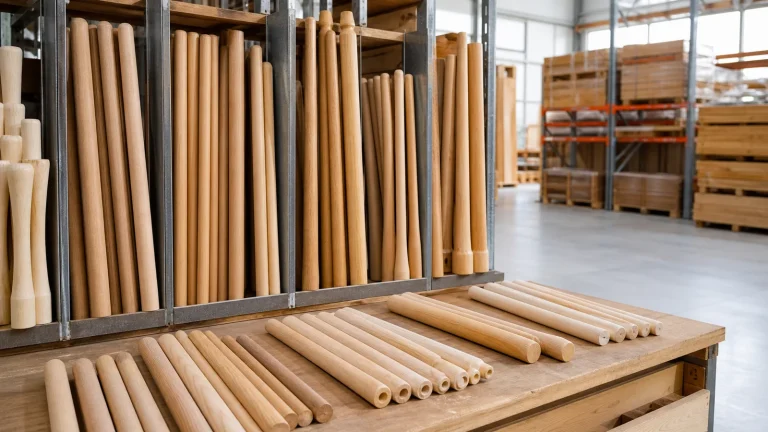
A request for “wood handles” is therefore too broad. Similar-looking handles can differ in material disclosure, grain direction, moisture condition, straightness, diameter or oval profile, taper geometry, hole placement, sanding level, coating, and packing. The buyer should define the handle as a standalone component and then approve its fit with the relevant tool head before production begins.
Start with the finished tool and its assembly method
The correct handle begins with the head it will carry and the way that joint will be made. A socketed shovel blade, an eye-type axe head, a hoe head, a rake socket, or another tool interface may require a different taper, insertion depth, shoulder, profile, and fastening arrangement. A handle that looks acceptable by itself can still be wrong if it bottoms out too early, sits loose, splits during fitting, or puts the head at an awkward angle.
Send the handle supplier a retained head sample, a controlled drawing, or both. The supplier should return a fitted sample that shows insertion depth, alignment, and the intended fastening method. If local assembly will use a screw, wedge, adhesive, ferrule, or another method, that detail belongs in the approval process. Do not assume one taper will fit every head simply because the outside diameter appears similar.
For a mixed tool program, keep each head-and-handle combination as its own approved SKU. A common handle family may reduce inventory, but it does not eliminate the need to verify fit on each tool model.
Material disclosure and grain direction support consistent quality
Buyers should ask the supplier to identify the wood material or material class used for the agreed handle model rather than relying on a generic phrase. The acceptable choice depends on the destination market, product position, handle length, intended use, local requirements, and available sourcing program. The purpose is traceability and consistent product definition, not a claim that one species is suitable for every tool or market.
Grain direction should be inspected because it affects appearance and the way a handle behaves under normal use and assembly. Look for a generally continuous grain direction along the handle, avoid obvious short-grain sections around a narrow taper or shoulder, and define what visible knots, checks, splits, or discoloration are acceptable for the product grade. Natural variation is normal in wood; uncontrolled defects are a different issue.
Approved samples should show the practical visual standard. A trade-grade bulk handle and a retail-facing finished handle may not require identical appearance, but both should be consistent within the stated grade and free from defects that interfere with assembly or handling.
Moisture condition matters before shipping and assembly
Wood changes with its environment. A handle that is assembled, packed, and shipped without suitable moisture control can later shrink, swell, warp, check, or change its fit at the tool head. The buyer should agree how moisture will be checked, which representative pieces will be sampled, and how the supplier will store handles before packing. The required range depends on the handle material, finish, destination climate, and assembly timing, so it should be defined for the actual program rather than copied from an unrelated product.
Receiving conditions matter as well. Long ocean transit, humid warehouses, wet pallets, or unprotected storage can affect even a well-made handle. Buyers should coordinate the factory's moisture-control process with inner wrapping, carton design, container protection, and destination storage. The goal is a handle that reaches assembly in the same controlled condition in which it was approved.
Profile, length, and taper should be measured, not estimated
Handle length, grip diameter, oval or round profile, taper length, end diameter, shoulder position, and straightness should be recorded with tolerances. These details influence balance, user comfort, joint fit, packing density, and the way the finished tool looks on a rack. Local trade descriptions often omit those values, so a drawing or dimensional sample is more reliable than a familiar name alone.
Straightness needs a practical inspection method. A slight visual variation may be acceptable for one product grade, while a pronounced bow can complicate assembly, retail presentation, and pallet stacking. Establish the check on an agreed reference surface or gauge, sample several bundles, and record the result against the approved standard.
The tapered end deserves a separate measurement. It must be compatible with the head socket or eye without forcing, excessive looseness, or improvised trimming at the assembly line. A simple assembly trial using retained head samples is more useful than an isolated handle measurement.
Sanding and finish should match the product channel
Sanding quality affects grip comfort, coating adhesion, splinter risk, and visible presentation. Inspect for rough zones, raised grain, sharp transitions, obvious machine marks, and incomplete sanding near shoulders and tapers. The order should say whether the handle is supplied unfinished for local treatment or with a defined coating or surface treatment.
For a retail-ready tool, finish consistency may matter strongly because the handle is a prominent visual component. For a bulk local-assembly program, the priority may be clean sanding, dimensional fit, and a surface ready for the destination process. These are different sourcing requirements and should not be merged into one vague “smooth handle” instruction.
Inspect samples across the bundle before packing
A practical pre-shipment check should confirm the handle model, material disclosure, overall length, profile dimensions, taper dimensions, straightness, grain appearance, visible defects, moisture-check records, sanding quality, finish, bundle quantity, carton condition, and marks. Inspectors should sample from different production periods and bundle positions rather than selecting a few clean pieces from the top layer.
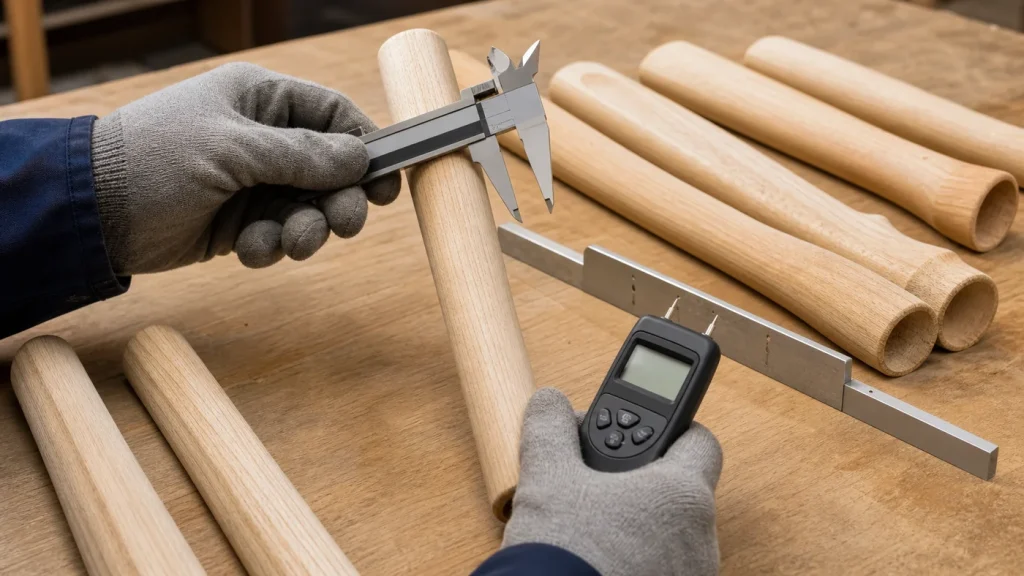
Use the approved tool-head sample for a fit check. Confirm insertion depth, alignment, and the condition of the handle after fitting. This does not require the factory to assemble every component; it confirms that the supplied handle is compatible with the agreed downstream process.
Bundle protection prevents transit damage and moisture exposure
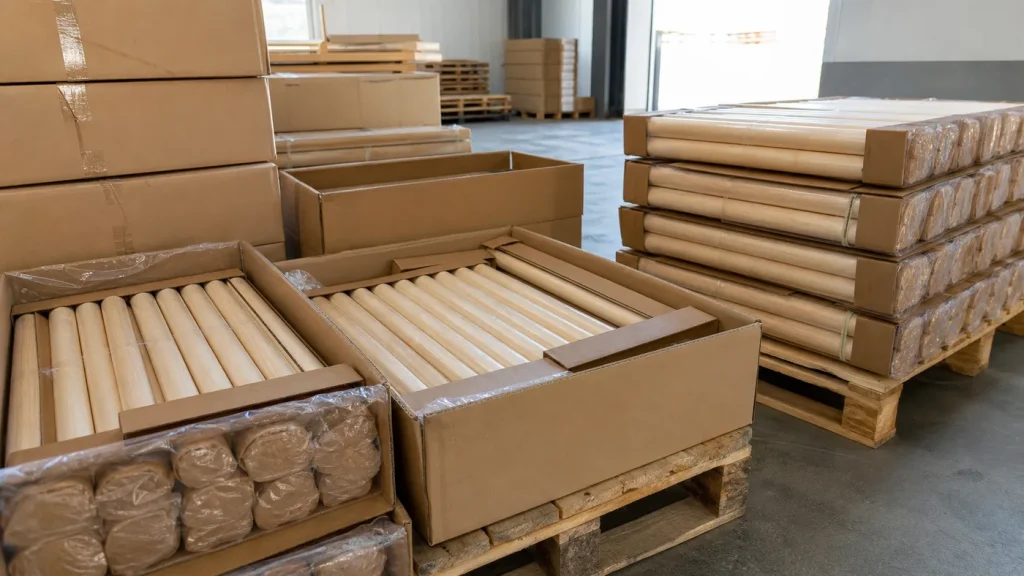
Long wooden handles are vulnerable to edge knocks, bending pressure, staining, and moisture exposure. The packing plan should define how handles are grouped by SKU and length, end protection, paper sleeves or other separators, inner wrap, carton dimensions, gross weight, pallet pattern, corner protection, and restraint. Different lengths should not be mixed unless the bundle is intentionally designed and clearly identified.
Aligned packing makes a real difference. Loose bundles can shift, rub against each other, or break carton corners. Over-tight strapping can mark softer surfaces or distort a bundle. A stable, supported pack protects the handle ends, keeps the quantity easy to receive, and reduces sorting work at destination.
Build a handle program around repeatable tool families
Importers rarely need every possible handle at once. A focused range of approved lengths, profiles, tapers, and finishes is easier to inspect, store, and reorder. The selection should follow the tool heads that are actually sold, local assembly capacity, destination market preference, and the warehouse's ability to handle long bundles safely.
Each handle SKU should retain its drawing or sample reference, compatible head model, dimensions, material description, moisture-control requirement, finish, bundle quantity, packing format, and quality checks. This makes it possible to compare repeat quotations accurately and prevents a familiar-looking handle from being substituted without approval.
Use an order sheet that connects the handle to the tool line
A complete wooden-handle order sheet should list the compatible tool head, approved sample or drawing, material disclosure, length and tolerance, profile dimensions, taper dimensions and insertion depth, straightness method, acceptable grain and defect standard, moisture-check method, sanding and finish requirements, bundle quantity, inner protection, carton and pallet plan, marks, and inspection records required before loading.
Wooden handle sourcing becomes dependable when the buyer treats the handle as a functional and visible component of the finished tool. Controlled material condition, grain, moisture, dimensions, head fit, surface quality, and protected bundling give importers a practical handle line that is easier to assemble, receive, and sell.