
Hexagonal wire netting is not simply a flexible version of welded mesh. Its performance, appearance, handling, and packing are shaped by a twisted hexagonal structure, a roll format, and a finished edge that must remain stable from the factory to the destination warehouse. For fencing, farm supply, garden, construction, and distributor programs, the buyer needs to control mesh opening, wire gauge, twist quality, roll dimensions, surface finish, and the way each roll is protected in transit.
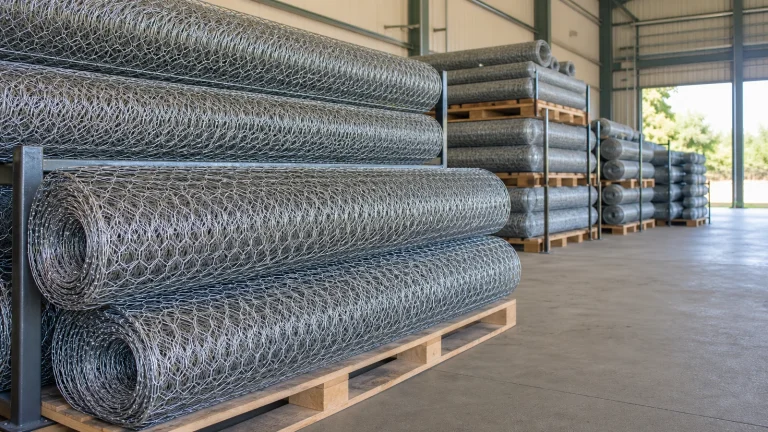
A generic request for “chicken mesh” or “hex wire” leaves too much to interpretation. Similar product names can cover different openings, wire diameters, widths, roll lengths, twist directions, selvage forms, finishes, and packing levels. The purchase order should define the actual roll the customer will receive, not just the broad product category.
Start with the use case and the finished roll size
The intended application guides the right combination of opening, wire gauge, width, and roll length. Farm and poultry channels, garden supply, light fencing, building-material distribution, and protective enclosures can require different product ranges. Buyers should describe the target channel, the required mesh configuration, and the way the roll will be sold or handled before asking for a quotation.
Record the nominal roll width, roll length, finished roll diameter, core or no-core direction where relevant, mesh opening, wire gauge, surface treatment, selvage type, roll quantity per bundle, and pallet plan. A wide long roll may have different handling and damage risks from a compact retail roll, even when both use the same hexagonal pattern.
Use an approved sample and a measurement sheet together. A photo shows the general appearance; it does not prove the opening, wire, edge, or roll tension that will be supplied in bulk.
Specify mesh aperture and wire gauge with a repeatable method
Aperture and wire gauge should be measured in a consistent way. The order should state the nominal mesh opening, which points are used for measurement, the wire gauge or diameter basis, and practical tolerances. Samples should be taken from more than one location along the roll because a mesh can look regular near the outer layer while drifting further into the roll.
Wire measurements need the same clarity. If a surface treatment changes the finished dimension, the buyer and supplier should agree whether the check refers to core wire, finished wire, or both. This avoids a dispute where each party measures a different aspect of the same product. The target is a consistent product matched to the approved specification, not an assumed universal standard.
Opening geometry matters for resale as well as use. Uneven hexagons, distorted mesh, or a visibly irregular pattern can make a roll harder to install and less attractive in a retail or farm-supply channel. Inspect both the central mesh and the area near the finished edge.
Twist quality and selvage keep the roll together
The twisted intersections are what distinguish hexagonal netting from a welded panel. Inspect the mesh for consistently formed twists, loose crossings, broken wires, excessive sharp projections, and areas where the pattern has opened or collapsed. A buyer should not assume every twist has the same job in every application, but the delivered mesh should match the approved construction and remain stable during normal unpacking and installation.
Selvage or edge treatment deserves a separate line in the specification. The edge may be finished in different approved forms depending on the product and market. Whatever form is selected, it should be consistent, free from dangerous loose ends, and suitable for rolling, bundling, and customer handling. A weak or irregular edge can let the roll unravel or create avoidable handling complaints.
Inspectors should look at the outer edges, the start and end of the roll, and several sections cut or opened from representative samples. A single neat exterior layer does not prove that the whole roll has been made consistently.
Choose the finish for the destination storage and sales channel
Galvanized or coated netting is purchased for appearance and for resistance to normal storage and transport conditions. The order should identify the selected surface treatment and the visual acceptance standard. Check the wire surface, twists, edges, and roll ends for early rust, uneven coverage, handling abrasion, bare-looking areas, or contamination from storage and packing.
Finish should be considered together with packing. A good factory surface can still be affected by moisture, condensation, abrasion between rolls, or damaged wrapping during sea freight and warehouse storage. The buyer's inspection plan should therefore connect the material finish with dry storage, roll protection, pallet stability, and the expected route.
Roll tension and dimensions affect receiving work
A roll needs to be tight enough to keep its shape and manageable enough to unroll without excessive distortion. Loose rolls can telescope, snag, or occupy inconsistent volume. Over-compressed rolls can make it difficult for a distributor to identify the product or handle the edge safely. The buyer should define the nominal roll dimensions and inspect the outside shape, bundle stability, and the condition of the roll ends.
Check roll length by an agreed method rather than assuming all rolls contain the same quantity because their outside diameter looks similar. Packaging weight can be a useful supporting check, but it does not replace a clear length-control process. The receiving warehouse should be able to identify each roll size and opening without unwrapping every bundle.
Use a roll-focused pre-shipment inspection plan
A practical inspection should confirm the model, aperture, wire gauge, twist condition, edge form, roll width, roll length-control method, roll diameter, surface finish, bundle quantity, wrapping, pallet stability, and marks. Samples should be selected across production times and pallet locations, not only from one clean bundle at the loading area.
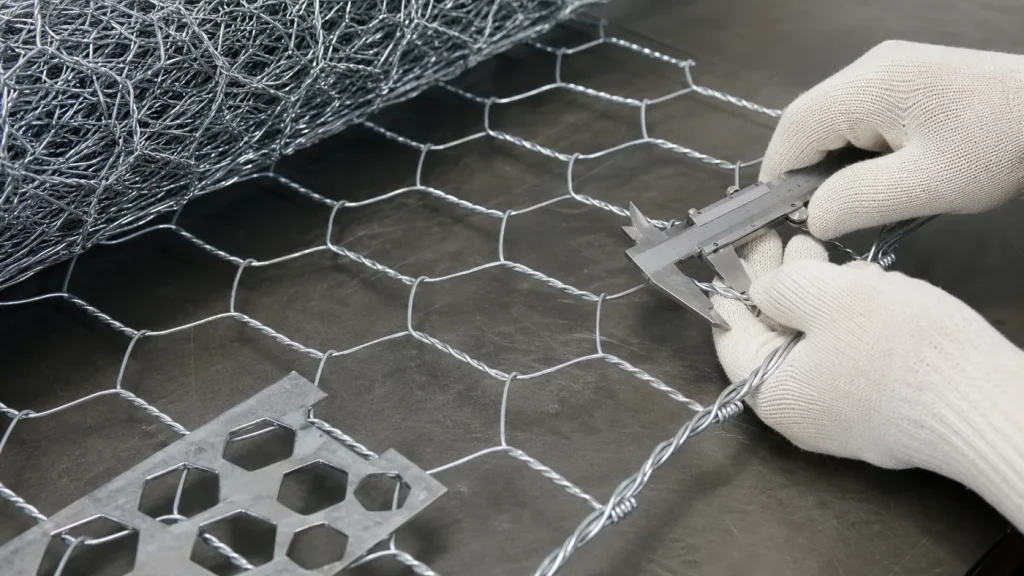
Photos should show the actual mesh opening, twist, edge, roll end, finished bundle, and pallet. These records help the buyer compare the shipment with the approved reference and give the destination team a clear receiving standard.
Protect roll ends, edges, and bundles during export
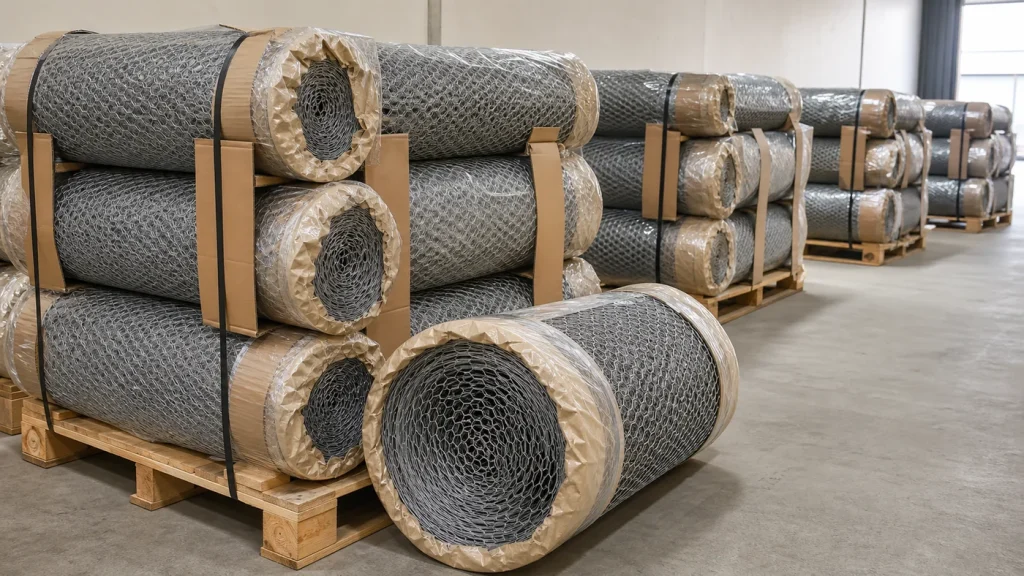
Hexagonal netting rolls can be damaged by edge abrasion, moisture, loose restraint, and impact on roll ends. A practical packing plan defines whether rolls are individually wrapped or bundled, how the ends are protected, the separator or sleeve material, binding method, bundle weight, pallet layout, corner protection, and stretch wrap. Rolls with different widths or openings should not be mixed unless the bundle is intentionally designed and clearly identified.
Rolls should be supported so they cannot shift or crush during loading. The pallet needs to suit the bundle weight and the direction in which rolls will be handled by forklift. A container may still have unused cubic space after a safe load is reached; buyers should prioritize stable restraint, realistic weight distribution, and destination unloading capacity over maximum visual fill.
Build a controlled roll assortment
A focused group of fast-moving openings, gauges, widths, and lengths is easier to quote, inspect, store, and reorder than a large set of near-duplicate rolls. The assortment should follow the destination channel, customer handling habits, available storage, and the product line that distributors can explain and replenish reliably.
Each SKU should retain its approved sample or drawing, opening, wire gauge, roll dimensions, finish, edge form, bundle quantity, packing method, and inspection checks. That record makes repeat quotations comparable and prevents a familiar-looking roll from being substituted without approval.
Use an order sheet that prevents avoidable variation
A complete hexagonal-netting order sheet should include the intended channel, approved sample reference, mesh opening and tolerance, wire gauge and measurement basis, twist construction direction if relevant, selvage form, surface finish, roll width and length, roll-diameter expectation, length-control method, bundle quantity, end protection, wrapping, pallet plan, gross-weight limit, marks, and pre-shipment inspection points.
Hexagonal wire netting becomes a dependable repeat category when the buyer controls the product as a finished roll: accurate opening and wire, stable twists, clean edges, suitable finish, manageable roll tension, and protected export bundles. These details make a basic wire product easier to receive, install, and sell.