
Wire mesh, nails, and fasteners are often treated as simple hardware products. In real import work, they are not simple. Small differences in wire diameter, mesh opening, nail length, shank type, coating, packing strength, or moisture protection can change the landed value of the shipment.
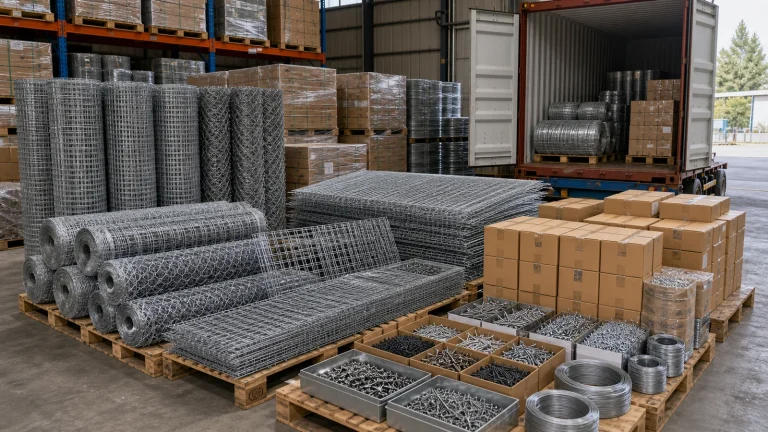
These products are also heavy, dense, and sometimes easy to damage through rust, deformation, carton failure, or poor sorting. For hardware importers, wholesalers, distributors, and retail buyers, the procurement plan should be built around specification accuracy and logistics control, not only the factory price.
A good sourcing plan separates the product problem into several practical checkpoints: what specification is being purchased, how the coating is controlled, how the goods are packed, how the weight is loaded, and how the buyer will receive and sell the shipment after arrival.
Start with exact specifications
Wire mesh orders should not be described only as “galvanized mesh” or “welded mesh.” The buyer should define the wire diameter, mesh opening, roll width, roll length, panel size, edge treatment, surface finish, packing method, and tolerance expectations. For hexagonal wire netting, welded wire mesh, galvanized mesh rolls, and wire panels, the same product name can represent very different real goods.
Nails and fasteners require the same discipline. Common nails, concrete nails, roofing nails, coil nails, screws, and other fasteners should be confirmed by length, diameter, head type, shank type, point, material, finish, quantity per carton, carton weight, and packing style. A product that looks correct in a small sample can create warehouse problems if carton weight, finish, or size sorting is wrong.
Importers should also avoid mixing trade names with technical descriptions. Local buyers may use familiar names, but the purchase order needs measurable specifications. The more basic the product looks, the more important it is to remove ambiguity before production.
Coating and surface finish affect real value
For wire mesh and nails, surface treatment is not a small detail. Galvanized finish, black finish, polished finish, painted surface, or other coating choices affect appearance, rust resistance, shelf life, customer use, and claim risk. A buyer should know whether the finish matches the destination market and the product application.
With wire mesh, coating consistency matters across the roll or panel. Poor coating can show up as dull patches, uneven surface, early rust, weak weld areas, or customer complaints after storage. With nails and fasteners, coating issues can create corrosion, dirty cartons, stuck pieces, or inconsistent appearance within the same package.
The buyer does not always need the highest coating level. The buyer needs the correct coating for the product use and price position. Agricultural fencing, light garden mesh, construction mesh, retail nails, and project fasteners may require different levels of finish control. The purchase plan should make that clear.
Quality control should be measurable
Because these products are repetitive, inspection should be built around measurable checks. For wire mesh, the inspection team should check wire diameter, opening size, roll or panel dimensions, weld condition, edge condition, surface finish, roll tightness, packing, and count. For nails and fasteners, the team should check length, diameter, head shape, shank style, point, finish, carton quantity, carton strength, and weight.
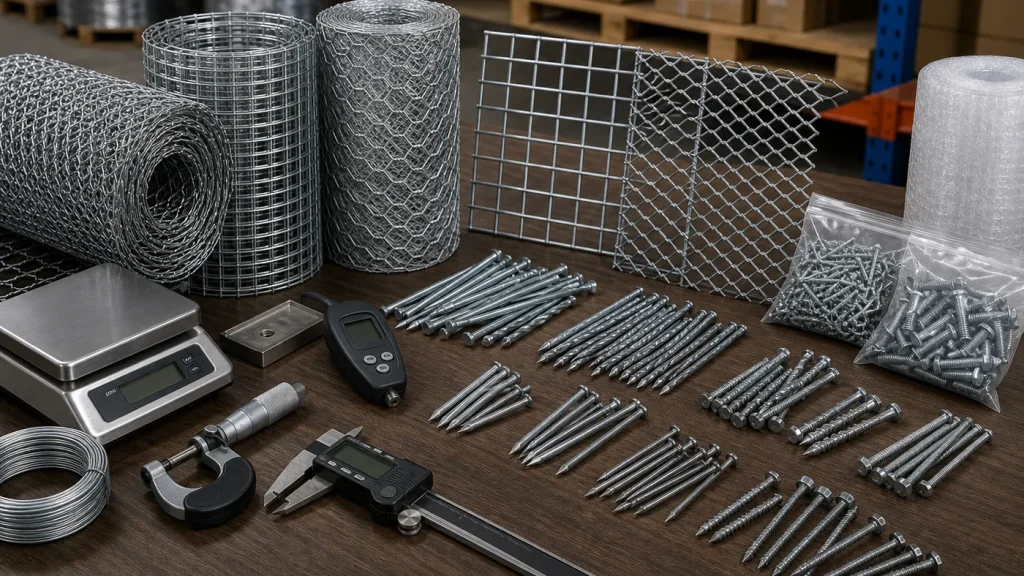
Sampling should cover different cartons, pallets, and production batches. If the buyer only inspects a few clean samples on a table, the shipment may still contain mixed sizes, weak cartons, bent mesh, rust-prone pieces, or inconsistent packing. A practical inspection plan follows the goods from sample approval through packed cargo.
Buyers should also photograph and record approved samples, carton marks, packing layers, and pallet condition. This gives the receiving warehouse a reference point and reduces disputes when the shipment arrives.
Packing is part of the product
Wire mesh is vulnerable to deformation, edge damage, roll loosening, and moisture exposure. Nails and fasteners are vulnerable to carton breakage, weight overload, rust, mixed contents, and sorting problems. Good packing is therefore part of the product value, not only a shipping detail.
Wire mesh rolls may need tight rolling, binding, plastic wrap, edge protection, pallet support, and clear separation by specification. Welded panels may need flat stacking, corner protection, and stable pallets. Nail cartons need strong board, inner bags or liners when needed, reasonable carton weight, and secure sealing. Heavy cartons should be designed for real handling, not only for factory storage.
Moisture control deserves special attention. Long ocean transit, container temperature changes, port delays, and destination warehousing can all create rust risk. For sensitive products, buyers should consider moisture-resistant packing, dry storage before loading, desiccant use where appropriate, and container condition checks.
Container planning must respect weight
Wire mesh, nails, and fasteners can make a container heavy quickly. The buyer should not plan the shipment by cubic space alone. Pallet weight, carton weight, roll density, loading sequence, and destination unloading method all matter.
A shipment with dense nail cartons and tightly packed wire mesh may reach practical weight limits before the container looks full. This can increase inland transport risk, make unloading harder, and create extra handling cost. The loading plan should balance heavy cartons, mesh rolls, panels, pallets, and any lighter supporting items.
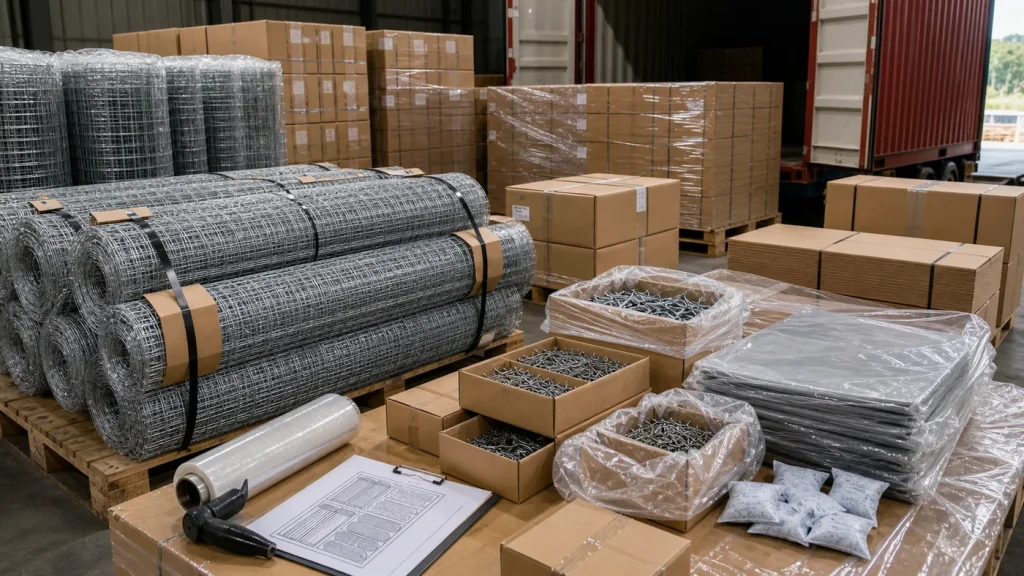
The buyer should also think about arrival workflow. If several wire mesh specifications and multiple nail sizes are loaded without clear separation, the receiving warehouse may spend too much time sorting. Clean pallet grouping and carton marks reduce labor cost after arrival.
Separate bulk trade goods from retail goods
Wire mesh and nails may be sold as bulk trade goods, contractor supplies, farm supply products, or retail packs. The sourcing plan should match the sales channel. A wholesaler may care most about stable specification, pallet strength, and low handling cost. A retailer may need smaller cartons, cleaner packaging, barcodes, shelf labels, or more careful appearance control.
For bulk goods, the priority is often durability, accurate count, stable coating, and efficient unloading. For retail goods, the priority expands to presentation, pack size, clean labels, consistent finish, and consumer-ready sorting. Mixing these two purposes in one purchase order can create problems unless the buyer separates the SKUs clearly.
This is especially important for nails and fasteners. A 25 kg trade carton and a small retail box are not the same sourcing problem. They may require different carton structures, labels, inner packing, inspection methods, and warehouse handling.
A practical order starts before production
The best time to control wire mesh, nails, and fasteners is before production starts. The buyer should approve specifications, samples, packing, carton marks, pallet plan, moisture protection, and inspection checkpoints early. Waiting until loading day makes it difficult to correct coating, carton strength, roll size, or mixed specifications.
For hardware importers, these products can be strong repeat categories. They support farms, contractors, builders, hardware stores, fencing projects, repair work, and retail shelves. But repeat sales depend on consistency. A buyer who controls specification and packing earns trust faster than a buyer who only chases the lowest unit price.
That is the real procurement lesson. Wire mesh and nails may look basic, but they need disciplined sourcing. Clear specifications, measurable inspection, stable coating, moisture-safe packing, and realistic container planning turn basic hardware into a reliable export shipment.