
Axes and hammers are familiar hardware products, yet they create serious sourcing problems when buyers compare only head weight and unit price. A tool can look substantial while the head is poorly seated, the handle grain or fit is weak, the striking face is inconsistent, the finish hides rough production, or the packing allows tools to damage each other in transit. In this category, the working end, the handle connection, and the packing all matter.
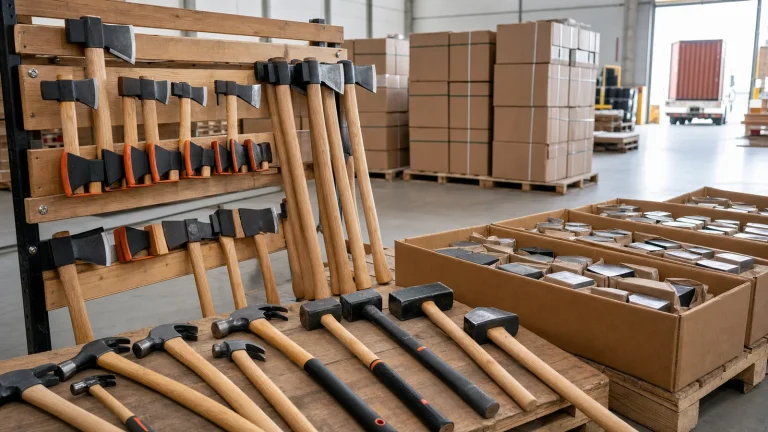
For farm supply distributors, hardware wholesalers, building-material dealers, retail chains, tool brands, and mixed-container buyers, axes and hammers can be useful repeat items. They serve wood processing, household repair, construction work, framing, demolition, workshop use, and seasonal outdoor programs. The category is broad enough to create a practical range, but only if each model is specified for its real use.
A reliable purchasing plan separates the tool type, head pattern, nominal head weight, eye construction, handle material, joint method, finish, protective accessories, carton plan, and inspection requirements. This makes quotations more comparable and helps the receiving team identify what was actually supplied.
Start with the work, then choose the head pattern
An axe, hatchet, splitting axe, felling axe, claw hammer, club hammer, ball-peen hammer, and sledge hammer do not belong in one generic “heavy tool” grade. Their balance, working face, handle length, and safety expectations are different. A buyer should first state the work scenario and the expected user.
A small hatchet may suit camping, household, or garden channels where compact size and retail presentation matter. A splitting axe needs a head geometry that supports splitting work and a handle that can manage repeated swings. A claw hammer is normally selected for driving and removing nails in general construction or household repair. A club hammer is more suitable for controlled impact and heavier striking jobs. A ball-peen hammer may be required for workshop or metalworking channels where its rounded peen has a defined use.
This step prevents misleading comparisons. Two heads may have a similar quoted weight but be shaped for different work. A retail buyer also needs to know whether a model is intended as an entry-level household item, a trade tool, or a more demanding professional product. The right assortment is a clear ladder of uses and price points, not a long list of visually similar heads.
Head weight is useful only with balance and dimensions
Head weight affects impact, user fatigue, freight cost, carton load, and the perceived strength of the product. It should be recorded by model, but it should never be the sole specification. A heavy axe head on a poorly matched short handle can feel awkward. A hammer that is heavier than the approved sample may add unnecessary freight cost and may not suit the intended task. A head that is lighter than expected can reduce buyer confidence and change the way the tool performs.
Importers should specify nominal head weight together with acceptable tolerance, overall tool length, head length, face or blade dimensions, eye dimensions, and handle length. For repeat orders, weighing samples from different cartons is a simple way to detect unwanted drift. The results should be retained with the model reference and production batch.
Balance deserves a practical check. With the correct handle and head combination, the tool should feel stable when held and should not show an obvious twist or off-center alignment. This is especially important for axes, where an incorrect head angle or poor handle fit can affect both user comfort and safe control.
Forging and heat treatment must suit the working area
Tool heads may be forged, formed, machined, or produced by different controlled processes depending on the product grade. The buyer does not need to prescribe a factory process without reason, but the supplier should be able to explain how the head is made and how key areas are controlled. For an axe, the blade area and the eye around the handle are important. For a hammer, the striking face, neck, claw or peen, and eye are all relevant.
Heat treatment is about a workable balance, not a single number applied to every tool. An axe blade needs practical edge durability without becoming fragile. A hammer face needs to withstand repeated striking without obvious deformation or chipping. The body of the head also needs toughness, because the eye and neck can be stressed during use. A tool that is too soft may mushroom, bend, or lose its edge quickly. A tool that is too brittle may crack or chip under impact.
For sourcing purposes, the buyer can define the intended use, approved sample, material expectation where appropriate, and functional inspection points. This gives the supplier a clear product target without creating false confidence from an isolated laboratory term that does not reflect the finished tool.
The eye, wedge, and handle joint are critical safety points
The eye is the opening through which a wood or composite handle connects to the head. Its shape, finish, taper, and fit decide whether the joint is secure. A loose eye, poorly fitted wedge, short insertion, damaged handle top, or badly aligned head can turn an ordinary quality issue into a safety problem. These points should be inspected before a shipment is approved.
For wood handles, buyers should define the handle profile, length, diameter, surface finish, and joint method. The wood should be practical for the chosen channel, reasonably straight, and free from defects that obviously weaken the critical handle area. A wedge or other retention system must be properly seated and should not leave the head visibly loose. The exact construction may vary by model, but it must be consistent with the approved sample.
Fiberglass and tubular handles need their own controls: grip fit, handle wall consistency, end cap condition, and a stable connection to the head. A composite handle can offer a clean retail appearance, but it is not automatically better if the head-to-handle attachment is weak. Importers should compare complete tools as assembled systems rather than judging the head and handle separately.
Inspect axe blades and hammer faces for usable geometry
For axes, the buyer should look at blade profile, edge straightness, bevel consistency, head alignment, burrs, sharp exposed corners, and protective guard fit where a guard is supplied. The goal is not to demand an unrealistic decorative finish. The goal is to make sure the working edge and head shape are consistent with the approved product.
For hammers, check the striking face for even shape, a clean surface, and no obvious defects that could affect use. The claw, peen, or other secondary working end should be aligned and formed cleanly. Rough flashing, cracks, sharp unintended edges, off-center faces, or severely uneven finish are signs that the tool needs closer review.
Some product differences are commercial rather than functional. A polished face, colored handle, painted head, or retail sleeve may be important for a consumer display. A construction distributor may prioritize dependable head and handle construction over cosmetic detail. The specification and acceptance criteria should reflect the buyer channel instead of applying one visual rule to every model.
Quality control should combine measurements with practical handling
A useful inspection checklist includes model identity, head weight, overall length, head dimensions, blade or striking-face condition, eye size, handle fit, wedge or retention method, head alignment, finish, protective guard, packing quantity, carton condition, and carton marks. The checklist should identify the few points that cannot be compromised for that specific model.
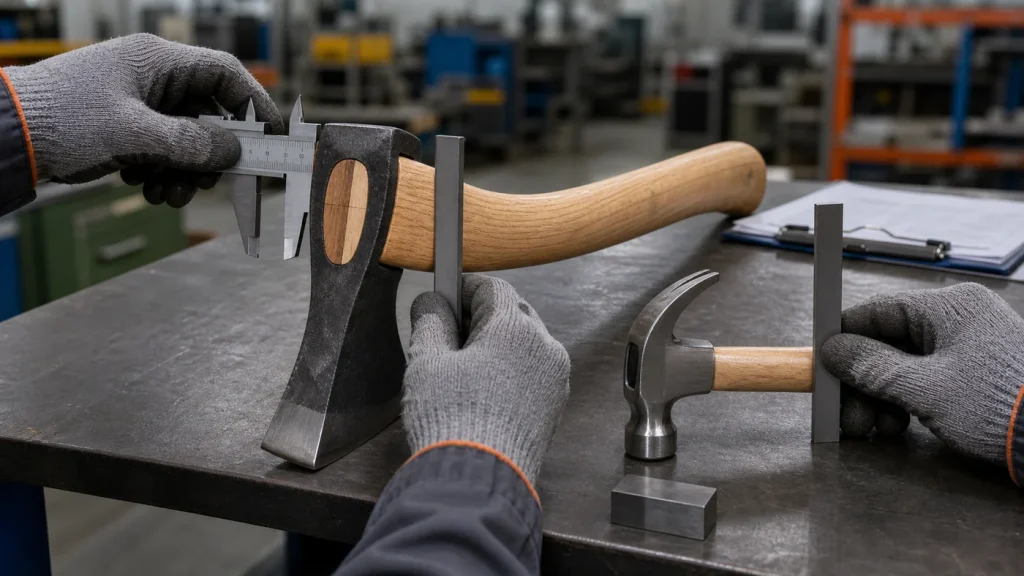
Sampling from several cartons or pallets matters. A single attractive sample does not prove that the production lot is consistent. Inspectors should look at different carton positions and record the model, batch, and carton reference in photos. For repeat orders, the buyer can keep an approved sample and prior measurements as a simple comparison benchmark.
Practical handling checks are valuable. They can reveal whether an axe head is visibly loose, whether a hammer sits straight on the handle, or whether a guard falls off immediately. These checks should be controlled and appropriate to the product. Their purpose is to identify clear manufacturing drift before export, not to simulate uncontrolled field use.
Handle materials affect retail position, freight, and claims
Wood handles, fiberglass handles, steel handles, and rubberized grips create different results in cost, appearance, feel, and packing. Wood can support a traditional tool range, but it needs consistent shaping, sanding, finish, and moisture control. Fiberglass can support a more finished retail look and may allow molded grip details. Steel-handled tools may suit specific impact tools but must be evaluated for weight, coating, grip comfort, and the connection to the head.
The choice also affects shipping. Long handles determine carton length and can make complete tools more volume-heavy. Head-only supply may reduce volume, but it moves assembly and local quality control to the buyer. For an importer with local handle supply or established assembly, head-only programs may be logical. For a retail chain needing shelf-ready tools, complete assembled products are usually easier to receive and display.
Private-label programs need additional control over color, grip texture, barcode position, hang tags, sleeves, warning information, and packaging layout. Wholesale programs may focus more on durable master cartons and clear model separation. Both routes need a defined packing standard.
Safe packing protects people, finish, and carton integrity
Axes and hammers are dense, heavy, and capable of damaging nearby products if they move inside a carton. Axes should have practical blade guards, sleeves, or protective material where the product and channel require it. Hammer heads need dividers or packing positions that prevent metal-to-metal contact and reduce scuffing. Carton strength must match actual gross weight rather than a target piece count alone.
Head-only orders need separation around striking faces and blade edges, plus clear markings so the receiving team can distinguish models. Complete tools need stable placement so long handles are not bent or forced against carton ends. When wood handles are packed separately, bundle size, end protection, and moisture exposure should be considered early.
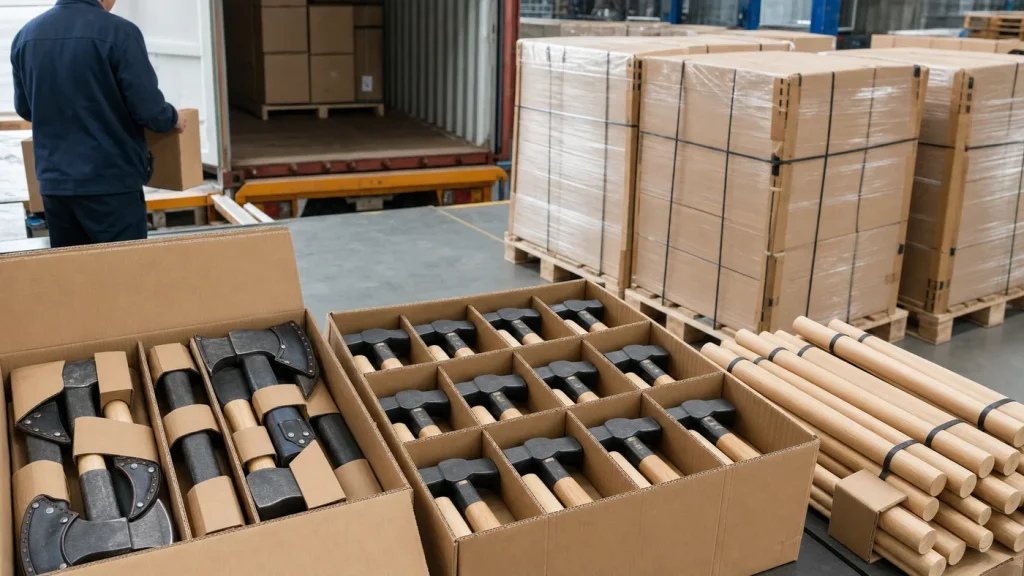
For mixed containers, place dense cartons so they do not crush lighter retail packaging. Keep long-handle bundles stable, protect sharp working edges, and plan the unloading sequence. Good packing reduces freight claims and helps the warehouse put each model into stock without excessive sorting or repacking.
Build the range by user and channel
A farm supply distributor may need splitting axes, practical hatchets, and robust hammers in a small number of strong models. A building-material wholesaler may focus on claw hammers, club hammers, and durable striking tools that move alongside other construction hardware. A retail chain may need a visible good-better-best range, clean finish, protective covers, and barcode-ready packing. Each route needs a different product mix.
Importers should avoid filling the order with too many similar head weights or handle styles. A focused assortment is easier to quote, inspect, stock, and reorder. It can include a compact household hatchet, a full-size splitting axe, a general claw hammer, a heavier club hammer, and a workshop-oriented model where the buyer channel supports it. The exact range should follow local demand and intended use.
These tools can also fit into a wider hardware program. Their density may complement bulkier products in a mixed container, but weight distribution and carton strength must be planned carefully. The category becomes more predictable when product selection, safety protection, and logistics are designed together.
A clear order sheet makes the shipment repeatable
An effective order sheet should record tool type, intended use, head pattern, nominal head weight and tolerance, head dimensions, eye dimensions, handle material, handle length, handle profile, joint or wedge method, finish, guard or sleeve requirement, unit weight, packing quantity, carton dimensions, carton weight limit, pallet plan, and inspection points. The buyer should indicate which criteria are critical for acceptance.
For a retail axe, guard fit, shelf presentation, and a clean handle finish may carry significant weight. For a construction hammer, head alignment, striking-face condition, and handle retention may be more important. For head-only supply, eye dimensions and protective packing can be central. Writing these requirements before production gives the buyer a realistic basis for supplier comparison and pre-shipment inspection.
Axes and hammers are working tools. They should be purchased as complete systems in which head pattern, material control, handle connection, finish, safety protection, and packing all support the way the product will be used and sold. That discipline turns a basic hardware category into a dependable repeat line instead of an avoidable claim risk.