
Concrete nails are bought for a demanding fastening situation, not simply because a buyer needs another nail SKU. They are expected to be driven into suitable masonry-related substrates and are therefore specified around hardened material condition, point quality, shank geometry, length, diameter, head shape, finish, and packing strength. For hardware importers and building-material distributors, a product that appears similar in a factory photograph can behave very differently when dimensions, hardening, or batch consistency drift.
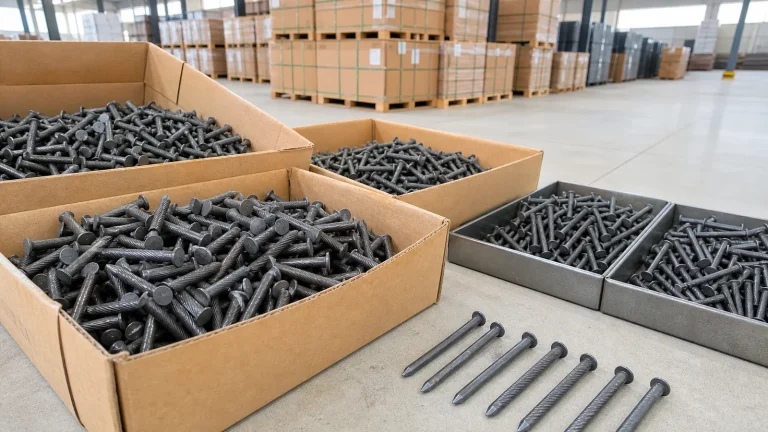
A clear order turns the intended application into measurable controls. The buyer should define the nail model, nominal length and diameter, head profile, shank style, point profile, surface finish, packing format, carton-weight limit, and inspection standard. The objective is not to promise one nail will suit every concrete or masonry condition. It is to make sure the delivered product matches the approved model and the channel that will sell it.
Separate concrete nails from ordinary general-purpose nails
Concrete nails differ from ordinary low-carbon general-purpose nails because their material condition and design are intended for harder fixing work. A supplier quotation should make that distinction visible. Do not accept a generic description such as “steel nails” when the buyer needs a hardened concrete-nail line. The order and sample should identify the head, shank, point, finish, and expected hardness-control process for the actual model.
Start with the target sales channel. Building-material dealers may want bulk cartons of a focused range of lengths. Hardware wholesalers may need a blend of trade packs and smaller boxes. Retail programs can require a visually consistent finish and clean piece-count presentation. The destination market, local installation practice, substrate type, and intended fixing work should guide the range. Product names alone are not enough because familiar trade names can describe different sizes or shank patterns in different markets.
Keep the category separate from roofing nails. A wide umbrella head, for example, is designed for a different fastening context and does not define a concrete nail. Buyers should work from the approved concrete-nail sample, not from a broad fastener term or a product image from another category.
Specify length, diameter, head, shank, and point together
Length and shank diameter influence handling, packing weight, usable quantity, and the way a nail is selected by a trade customer. Both should be stated with practical tolerances. The head diameter and profile should also be agreed so the product remains recognizable, seats as expected, and presents consistently in a carton or small box.
Shank pattern is a separate choice. Smooth and fluted or grooved profiles are not interchangeable descriptions; they should be named and approved as part of the SKU. The buyer should inspect the shank for uniform forming, a clean transition below the head, and no deep defects that make the nail look weak or irregular. If a range includes both smooth and patterned shanks, keep them clearly separated in the order sheet, inner packing, and carton marks.
The point needs to be sharp, centered, and consistent. Bent, blunt, offset, or visibly damaged points complicate driving and create complaints even where other dimensions are correct. Sampling should compare points from several production positions, not only a small hand-selected group. A correct head and length do not compensate for poor point geometry.
Hardening must be controlled as a batch property
Hardening is central to concrete-nail sourcing, but it should not be treated as a marketing adjective. The buyer should ask how the supplier controls the heat-treatment process, which samples are checked, what test method is used, and how batches are identified. A nail that is insufficiently hardened may not match the intended fixing task. A nail that is excessively brittle can be prone to breakage under unsuitable conditions or rough handling. The correct acceptance range depends on the approved model and market, so it should be agreed with the supplier and, where relevant, the buyer's technical team.
Batch control matters because a good sample does not prove that every later carton has the same material condition. Request records that connect test samples to production lots. For repeat orders, compare the appearance, dimension measurements, and quality records against the retained approval sample. This gives the importer a way to identify an uncontrolled process change before it reaches distributors.
Do not create universal performance claims without application testing. Concrete and masonry vary substantially in density, aggregate, curing, thickness, and local installation practice. The procurement task is to source a consistent nail to a defined standard, then let the relevant buyer or installer validate suitability for the intended substrate and use.
Use a practical inspection plan before packing
Inspection should confirm product identity first: correct SKU, head profile, shank pattern, finish, and packing direction. It should then measure length, shank diameter, head dimensions, straightness, point condition, and piece weight or packing weight. Inspectors should take samples from multiple production times and cartons so that the result represents the batch rather than a selected tray.

The buyer can include a visual acceptance standard for burrs, plating or coating coverage, surface cracks, visible corrosion, and obvious deformation. A simple fixture can help check straightness. Measurements should be recorded with the model and lot reference, while inspection photos should show the actual product and packed presentation. This evidence is valuable when a distributor later asks whether a shipment matches the approved sample.
Choose the finish around storage and product presentation
Concrete nails may be supplied with different surface conditions or protective finishes depending on the selected product line and market. The order should state the required finish and the acceptable surface condition on arrival. Rather than relying on a vague phrase such as “good coating,” define whether the buyer is checking for uniform coverage, corrosion protection during normal transit and storage, a particular appearance, or a clean retail presentation.
Surface protection does not remove the need for sound packing and dry storage. Dense nails rub against each other during handling, and moisture can affect both the fastener and its carton. Inspect for early rust, bare-looking areas, coating flakes, oil contamination where it is not expected, and damage caused by torn inner packaging. The retained sample should show the practical cosmetic standard expected for the grade.
Heavy fastener cartons need a deliberate packing plan
Concrete nails are dense, so packing failures are often logistics failures rather than product-design failures. Weak inner boxes can split, loose nails can damage the master carton, and oversized cartons can become difficult or unsafe to lift. The buyer should define inner-box quantity or net weight, inner boxes per master carton, gross carton-weight limit, carton dimensions, pallet pattern, and required protection.
For trade supply, consistent weights and durable cartons may matter most. For retail, small packs need accurate counts, clean closure, and a master carton that prevents crushing. In both cases, mixed sizes or shank patterns should not be allowed inside a carton unless the assortment has been intentionally designed and clearly identified. Separating SKUs at the packing stage reduces warehouse sorting and customer claims.
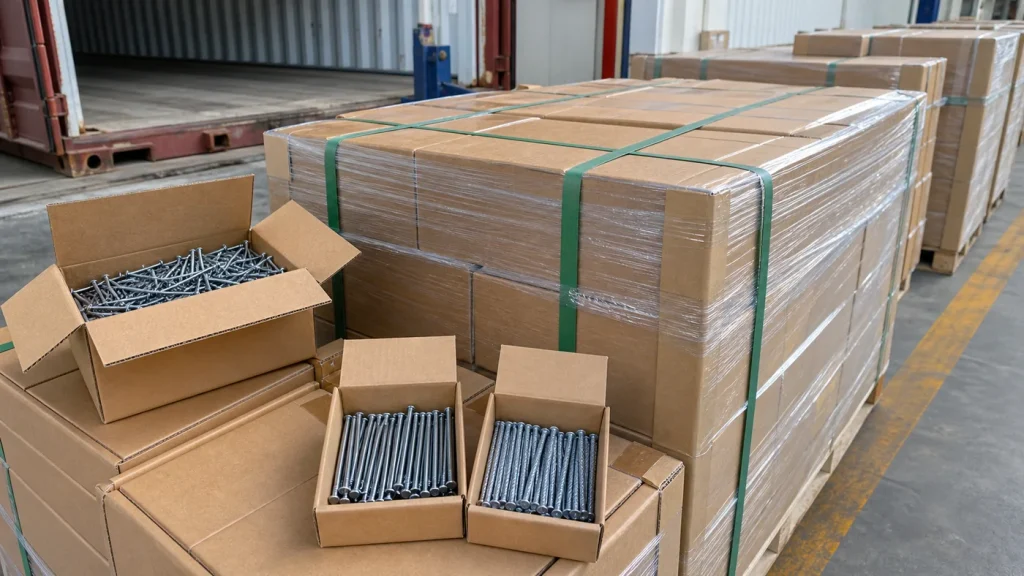
Container loading should account for the category's density. Nail cartons can help balance more volume-heavy building supplies, but they should not be positioned where their weight crushes lighter packs. Confirm the pallet capacity, container floor condition, loading sequence, destination unloading equipment, and moisture protection before dispatch.
Build a range that distributors can receive and reorder
A large number of nearly identical lengths can create unnecessary inventory and inspection complexity. Importers usually benefit from a focused range that follows local demand, installation habits, and the way their customers buy. A building-material dealer may need a few fast-moving bulk sizes. A hardware wholesaler may add selected smaller packs. A retail buyer may require a compact range with clear pack differentiation.
Each SKU should keep the same core fields: length, diameter, head, shank pattern, point, finish, pack quantity or weight, master-carton quantity, gross weight, and inspection requirement. This lets the buyer compare supplier offers accurately and helps the warehouse receive a repeat order without rebuilding the product definition from memory.
Use an order sheet that prevents avoidable variation
A complete concrete-nail order sheet should list the target application and channel, approved sample or drawing reference, nail length and tolerance, shank diameter and tolerance, head profile, shank pattern, point requirement, surface finish, hardening-control and test-record requirement, inner-pack format, master-carton quantity, gross-weight limit, pallet plan, marks, and inspection points. It should state which features are critical for the buyer's market.
Concrete nail sourcing becomes more dependable when it is treated as a controlled fastener program rather than a low-detail commodity purchase. Defined geometry, verified hardening process, batch-level inspection, appropriate finish, strong packing, and a practical SKU range give importers a product line that is easier to receive, sell, and reorder.