
Garden rakes and forks look like straightforward hardware items, but the category has more variation than many importers expect. A rake that looks good in a product photo can flex too easily, lose tines, develop a loose handle joint, arrive with damaged coating, or take up more container volume than the quotation allowed. A fork can look heavy-duty while the socket, weld, tine spacing, or handle connection is not suitable for the intended market.
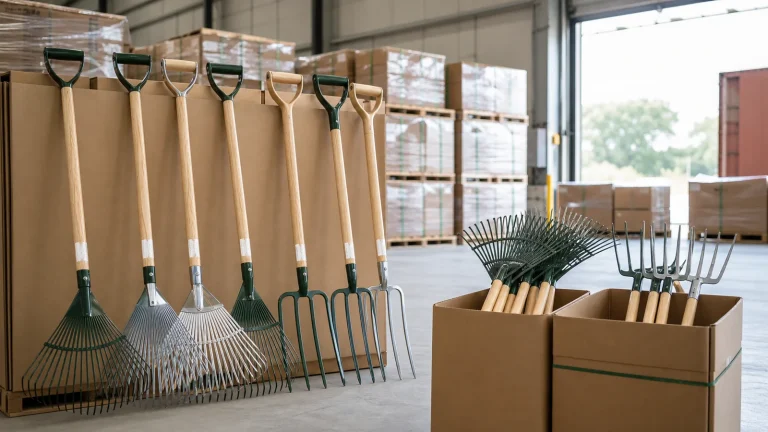
For garden centers, farm supply distributors, hardware wholesalers, retail chains, and mixed-container buyers, the answer is not simply to select the cheapest rake or fork. The more reliable approach is to define the work the tool must do, then control the parts that determine strength, feel, shipment cost, and shelf presentation.
Rakes and forks can cover leaf collection, soil leveling, cultivation, turning compost, moving loose material, light agricultural work, and professional landscaping. These uses need different head shapes, tine counts, steel sections, handle lengths, and price points. A clear purchasing specification helps a buyer compare suppliers on the same basis instead of comparing catalog images that hide important differences.
Start with the work scenario, not the catalog name
The word rake may describe a fan-shaped leaf rake, a bow rake, a straight landscape rake, a shrub rake, or a compact hand rake. The word fork can refer to a digging fork, border fork, manure fork, compost fork, or a fork designed for loose material. They may sit in one garden-tool category, but their working load and buyer expectation are different.
A wide fan rake is normally selected for collecting leaves and light debris. A bow rake is often chosen for leveling soil, spreading aggregate, or heavier garden work. A digging fork needs tines and a socket that can tolerate repeated leverage in soil. A manure or compost fork needs an open, practical tine layout that moves material efficiently. Before asking for a price, the buyer should define the user, the task, and whether the product is a light retail item or a more demanding professional tool.
This avoids a common sourcing mistake: ordering a tool that is technically a rake or fork but built for a lighter job than the target channel requires. A low unit price is not a saving when the product bends, feels unstable, or creates returns after the first selling season.
Tine count, spacing, and profile are product specifications
For rakes and forks, the tines do most of the working. Their number, diameter or section, spacing, length, curve, point shape, and connection to the head all affect performance. More tines do not automatically mean a better tool. A leaf rake may need closely spaced, springy tines to collect small debris. A bow rake may need fewer, more rigid tines to move soil and gravel. A digging fork needs tines spaced and shaped for soil penetration while still giving the user enough support for lifting and turning.
Importers should ask for drawings or approved samples that show the overall head width, tine count, tine length, spacing, and the profile of each tine. A measurement table is more useful than a general instruction such as “heavy duty.” It also makes it easier to inspect later batches, because an inspector can compare the actual product with an agreed reference.
Consistency matters as much as the nominal specification. Unevenly spaced tines can make a rake look poor on a retail shelf and may affect the way it collects debris. A fork with visibly misaligned tines can feel unbalanced and create a weak impression even before it is used. Samples should be viewed from the front and side, not only from above.
Steel section and controlled flexibility must match the tool
Garden-tool buyers often use simple terms such as thick steel, hard steel, or spring steel. Those descriptions are not enough on their own. The relevant question is whether the chosen material and forming create the right balance of stiffness, resilience, weight, and practical durability for the intended product grade.
Leaf-rake tines usually need controlled flexibility. If they are too soft, they may remain bent after normal use. If they are too rigid, they can be less forgiving and may deform at the joint or under impact. Soil rakes and digging forks normally need a more rigid working structure, but an overly heavy head can increase freight cost and make the tool less comfortable for everyday users.
A good sourcing program uses an approved sample and simple functional checks. The buyer can assess whether rake tines return to their intended shape after reasonable flexing, whether fork tines remain aligned after controlled leverage, and whether the head feels proportionate to the handle. These practical checks do not replace a full engineering test plan, but they are much better than relying on a product photo and stated weight alone.
The collar, socket, and weld area deserve close attention
The point where the head meets the handle carries repeated pulling, pushing, lifting, and twisting force. On garden rakes, this can involve a socket, ferrule, collar, rivet, or a welded joint. On forks, the socket and the area where the tines meet the crown are key stress points. If this construction is weak or inconsistent, a tool can become loose even when the tines themselves look strong.
Buyers should define the handle connection method, socket depth, rivet or fastener requirement where used, collar shape, and acceptable weld appearance. Inspection should look for incomplete welds, rough edges, cracks, thin sections, poorly seated handles, loose rivets, and inconsistent head angles. Paint can cover a rough production detail, so it is useful to check the construction closely rather than judging the product only after coating.
For a complete tool, the head should sit straight in relation to the handle. A visibly off-center rake or fork may still be usable, but it lowers perceived quality and can create repeated complaints in retail programs. For head-only orders, the socket dimensions must match the buyer’s local handle specification.
Choose handles as a product decision, not an accessory
Wood, fiberglass, steel, and tubular metal handles create different price, comfort, and logistics results. Wood is familiar in many garden and farm channels and can give a traditional, practical appearance. It also needs control over straightness, sanding, knots, moisture, diameter, surface finish, and fit. Fiberglass can support a more finished retail position, but grip design, wall consistency, end caps, and the connection to the head still need review.
Handle length should suit both the tool and the buyer segment. A short handle may work for compact garden tools or local assembly, while a full-length handle may be expected for soil work and landscaping. The handle is also a major factor in carton length and container volume. A buyer should compare head-only supply, separate handles, and fully assembled tools based on real receiving and sales needs, not only factory assembly cost.
When the tools are retail-ready, the handle finish, hanging hole, grip position, barcode area, warning label placement, and color consistency may be commercially important. For a wholesale agricultural program, sturdy bundle packing and a dependable connection may matter more than decorative details. The order sheet should make that priority clear.
Finish protects the product and the shelf appearance
Powder coating, paint, galvanizing, black finish, oiling, and polishing can all be used in garden-tool programs. The selected finish should be appropriate for the product, the buyer’s price point, and the expected storage conditions. Coating that chips during transit can expose bare metal and make a new tool look old before the customer uses it.
Buyers should agree on color, coverage, reasonable scratch tolerance, edge protection, and packing separation. For dark-coated rakes and forks, abrasion between stacked heads is a common practical concern. For long-distance sea freight or humid storage, the packing plan should include sensible rust prevention and moisture protection without creating unnecessary plastic waste or trapped condensation.
The finish should not be used to hide poor forming or weak joints. A clean coating improves presentation, but the underlying head, tines, welds, and socket must already meet the approved product standard.
Inspection should include function, alignment, and batch consistency
A useful pre-shipment inspection for rakes and forks does more than count cartons. It should verify model identity, head width, overall length, tine count, spacing, tine alignment, handle fit, socket or collar construction, surface finish, handle straightness, rivet or fastener presence, packing quantity, carton condition, and carton marks. The exact checklist can be adjusted for the product grade, but the critical points should be agreed before production.
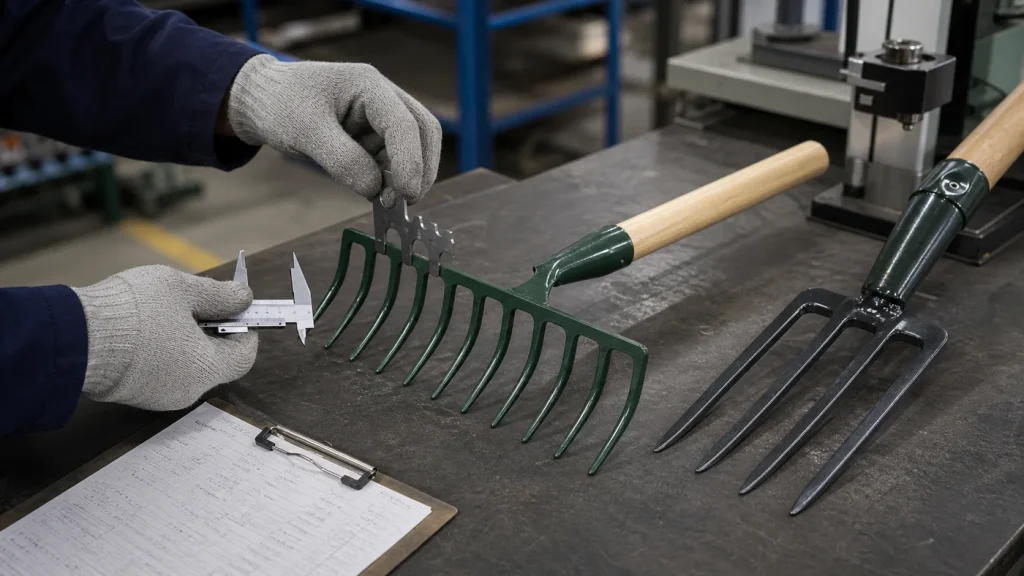
Inspection samples should come from more than one carton or pallet. A good first carton does not prove that the full shipment is consistent. For repeat purchases, retain an approved sample, photos of key dimensions, and a clear record of product weight and packing. This creates a benchmark when later production differs in feel, finish, or assembly quality.
Functional checks should stay practical. A buyer can confirm that rake tines are not visibly loose, that they recover reasonably after normal flexing, that fork tines are aligned, and that the handle does not move at the connection during controlled handling. The point is to detect obvious manufacturing drift before the shipment is sealed.
Pack heads and handles to protect both product and container space
Garden rakes and forks have awkward shapes. Finished long-handle tools can take up substantial cubic volume; loose heads can scratch each other; separate handles can be damaged if they are poorly bundled. The packing plan should protect the product while making loading and receiving efficient.
Nested rake heads can reduce volume, but the tines and coating need separators or protective material so metal does not rub against metal. Fork heads may need layered cardboard, edge protection, and controlled stack height so tines do not deform. Handles should be grouped by length and type, with protection at vulnerable ends. Cartons should match the actual weight and shape instead of being selected only by an optimistic piece count.
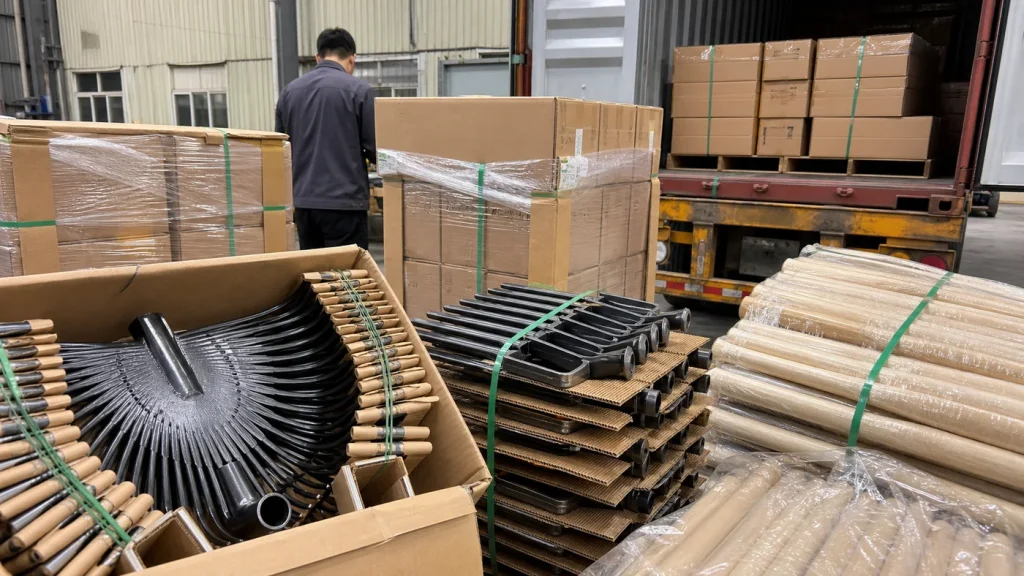
For mixed containers, rakes and forks should be positioned with their weight, carton strength, and unloading sequence in mind. Heavy tool heads should not crush lighter retail cartons. Long bundles should be stabilized so they do not shift in transit. A practical loading plan reduces damage and helps the warehouse separate product sizes without opening every carton.
Build assortments for the channel, not for maximum SKU count
A focused garden-tool assortment often sells better than a long list of near-duplicate models. A hardware wholesaler may need a few dependable workhorse SKUs: a leaf rake, a bow rake, a digging fork, and a compost or manure fork. A retail chain may need a more visible range with different head widths, coated finishes, and a clear good-better-best price ladder. A farm-supply buyer may prioritize stronger soil-working models and simple robust packing.
Each group should have a defined specification and packing method. It is risky to quote every rake and fork under one generic “garden tool” grade because the buyer then cannot tell where material, handle, or finish differences are coming from. Clear product groups make supplier comparison and reorder planning easier.
Mixed-container buyers can also use the category to balance their overall assortment. A carefully selected rake and fork range brings useful gardening and agricultural items into the same purchasing program without needing a full single-product container. The important point is that the mix remains commercially coherent and the heavy, long, and nested items are planned realistically.
A clear order sheet prevents avoidable claims
A practical order sheet should record product type, head style, head width, tine count, tine section or diameter, tine spacing, socket or collar construction, handle material, handle length, handle diameter, handle finish, head finish, color, unit weight target, packing quantity, carton dimensions, carton weight limit, pallet plan, and inspection points. It should also state which points are critical for the buyer’s channel.
For example, a leaf rake ordered for a garden center may require clean coating, consistent tine shape, a comfortable handle, and retail display details. A digging fork for farm supply may place more weight on tine alignment, socket strength, and practical packing. A head-only program may make handle socket dimensions the main control point. The specification should reflect the user who will actually hold the tool.
Garden rakes and forks become easier to source when buyers turn visual descriptions into measurable requirements. Tine design, joint construction, handle fit, finish, packing, and inspection are the details that separate a repeatable product line from a shipment that simply looks acceptable on the day it leaves the factory.