
Hoes and pickaxes are basic agricultural and construction tools, but basic does not mean risk-free. Importers often compare them by model shape and unit price, while the real cost problems come from head weight variation, weak eye fit, poor heat treatment, loose handles, paint failure, carton damage, and difficult receiving after shipment.
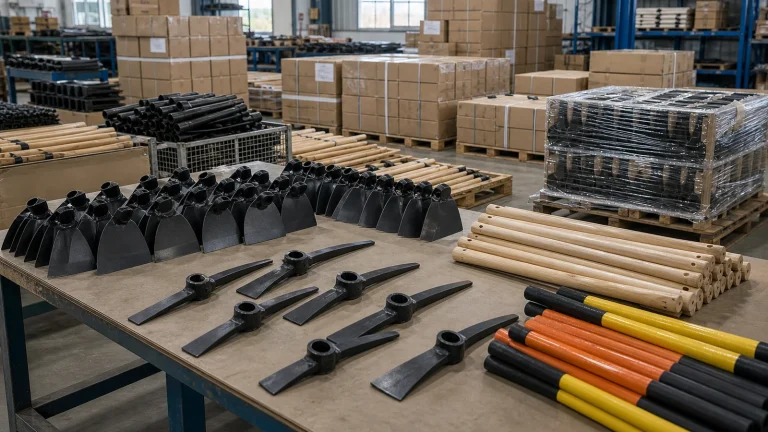
For farm supply buyers, construction hardware distributors, rural retail chains, garden centers, and mixed container importers, hoes and pickaxes can be dependable repeat items. They serve soil work, trenching, root clearing, road repair, light demolition, farm maintenance, and local assembly programs. The category is practical, but it rewards disciplined specification control.
A buyer who only asks for a hoe or pickaxe may receive a product that looks close to the catalog image but fails in use. A stronger sourcing plan separates product type, head weight, steel quality, eye size, handle requirement, finish, packing, and inspection before the order moves into production.
Separate the tool type before comparing price
Hoes, pickaxes, mattocks, adzes, fork hoes, and related digging heads may sit in the same product family, but they do not serve the same work. A weeding hoe, chopping hoe, heavy farm hoe, pickaxe, cutter mattock, and pick mattock all have different balance, head shape, impact area, and handle stress.
The first sourcing step is to define the intended work. Is the tool for light garden soil, hard farm ground, road work, stone removal, trenching, or construction repair? Is the buyer ordering heads only for local handle assembly, or complete tools ready for retail and wholesale distribution?
This matters because the right product is not always the heaviest product. A heavy head may feel strong, but it increases freight cost and user fatigue. A lighter head may be suitable for garden or retail channels but weak for harder field work. The specification should match the real user and sales channel.
Head weight must be controlled by tolerance, not by guesswork
Head weight affects tool balance, perceived quality, carton weight, landed cost, and user performance. If a supplier quotes a low price by reducing head weight, the product may look similar but feel weaker in the hand. If the head is heavier than planned, the buyer may face higher freight cost and packaging stress.
Importers should define nominal head weight and acceptable tolerance by model. This is especially important when a product line includes several sizes that look similar. A warehouse team should not need to discover after arrival that two sizes are hard to separate because weight and markings were not controlled.
A practical inspection should weigh samples from different cartons or pallets. The result should be recorded with model, batch, and carton reference. For repeat orders, head weight records help the buyer detect supplier drift before market complaints appear.
Eye size and handle fit decide assembly quality
The eye is one of the most important control points for hoes and pickaxes. If the eye is too wide, the handle may loosen. If it is too narrow or inconsistent, assembly becomes difficult and may split wooden handles. If the eye angle is wrong, the tool feels awkward and the handle may carry stress in the wrong direction.
Buyers should define eye diameter or eye dimensions, taper, oval or round shape where relevant, handle insertion depth, wedge or locking method, and acceptable fit. For head-only orders, the eye must match the local handle supply. For complete tools, the supplier must control both head and handle together.
Even small eye variation can create major labor cost when the buyer assembles locally. A good sourcing plan should include fit samples and a basic assembly check, not only a measurement on the drawing.
Forging, welding, and forming quality affect strength
Different hoes and pickaxes may be forged, stamped, welded, formed, or produced by mixed processes. The buyer should understand which process is used for the product grade. A light stamped hoe head may be suitable for garden retail, while a heavier digging tool may need stronger forming and better control around the eye and working edge.
Inspection should check cracks, rough seams, weak weld areas, thin spots, uneven forming, eye deformation, and poor grinding. These defects may be hidden by paint, so buyers should not rely only on final appearance. Samples before coating can sometimes reveal whether the base metal and forming are consistent.
For pickaxes and mattocks, the transition area around the central eye is especially important because impact force concentrates there. A supplier should be able to explain the production process and the control points that protect this area.
Heat treatment should match the work load
Heat treatment controls the balance between hardness, toughness, and deformation resistance. A working edge that is too soft may bend or mushroom quickly. A tool head that is too brittle may chip or crack under impact. The target should match the intended use rather than chasing a single hardness number without context.
For hoes, the working edge needs enough wear resistance while the body remains practical for field use. For pickaxes and mattocks, the points and blades must survive impact, but the head must not become brittle. Importers should agree on material, heat-treatment expectation, and functional tests for the product grade.
When the category is bought repeatedly, buyers can keep approved samples as a benchmark. This helps compare later batches by weight, edge behavior, impact area, and finish instead of relying only on supplier statements.
Quality control must include fit, weight, finish, and batch checks
A useful inspection checklist should cover model identity, head weight, head dimensions, eye size, eye angle, handle fit, edge condition, point shape, surface defects, coating coverage, handle straightness, handle moisture condition, carton strength, and pallet condition. These checks are simple, but they prevent many claims.
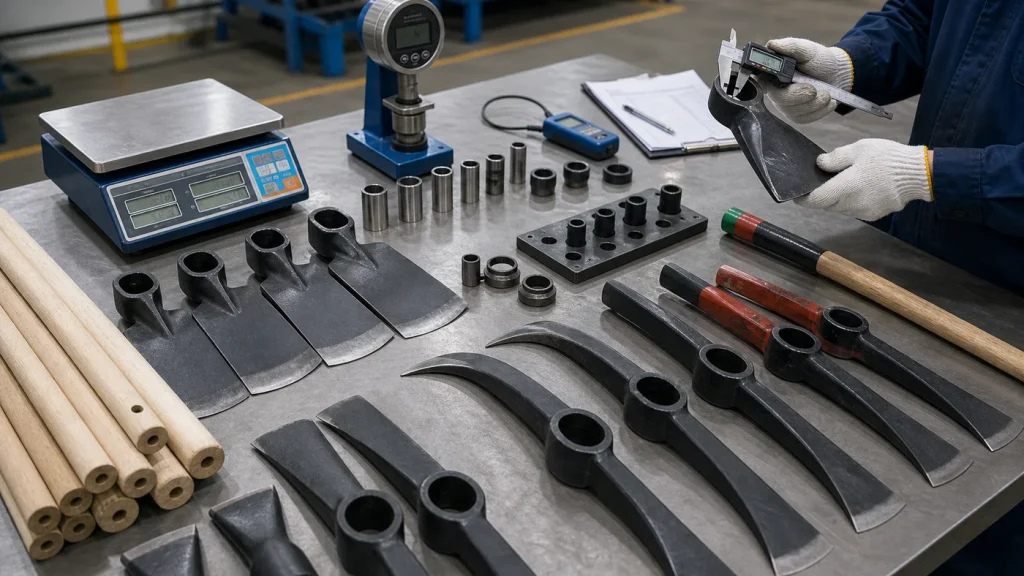
For complete tools, inspectors should check whether the handle is inserted securely, whether the head moves under reasonable handling, whether wedges or fasteners are correctly placed, and whether the tool angle feels consistent. For head-only orders, the focus is on eye consistency, carton separation, surface finish, and model marking.
Batch traceability matters because one mixed shipment can contain several sizes, finishes, and handle types. Carton marks should match the packing list, and inspection photos should show the exact models checked. This makes receiving and future reorders easier.
Handles are a separate sourcing decision
Wood handles, fiberglass handles, steel handles, and plastic-coated handles each create different cost and performance results. Wood handles may be preferred for traditional farm channels, but they need control over straightness, diameter, sanding, moisture, knots, and finish. Fiberglass handles may offer a cleaner retail appearance but require grip, diameter, and end-cap control.
Importers should not treat handles as a minor accessory. The handle affects user comfort, breakage claims, carton length, shipping volume, and local assembly efficiency. If the buyer purchases heads and handles together, the fit should be checked as a system.
For private-label or retail-ready programs, handle color, grip texture, label position, barcode placement, and hanger requirements should be confirmed before mass production. For wholesale farm tools, durability and bundle packing may matter more than decorative details.
Paint and surface finish protect both product and perception
Paint, powder coating, black finish, oiling, polishing, or anti-rust treatment should be chosen according to product type and market. Poor coating can chip during packing, expose rust, stain cartons, or make the tool look cheap on arrival. A good finish should protect the tool and support the expected price level.
Buyers should define acceptable color range, coating coverage, edge exposure, rust tolerance, scratch tolerance, and packaging protection. If tools are stacked metal against metal, the packing plan should prevent coating abrasion. For long sea freight or humid storage, rust prevention should be considered early.
The finish must also suit the channel. Construction buyers may accept a practical finish if the tool is strong. Retail buyers may judge surface consistency much more strictly. The inspection criteria should reflect that difference.
Packing should separate heads, handles, and finished tools clearly
Hoes and pickaxes are heavy, awkwardly shaped, and sometimes sharp at the working edge. Packing should protect the product and the people handling it. Head-only orders may need carton dividers, edge protection, oil paper, bundle wrapping, or stronger master cartons. Handles may need bundle wrapping, end protection, moisture control, and size separation.
Complete tools create different problems because long handles increase carton length and volume. A buyer may save labor by ordering complete tools, but the freight and breakage risk can be higher if packing is weak. Head-only supply can reduce volume but requires local assembly control.
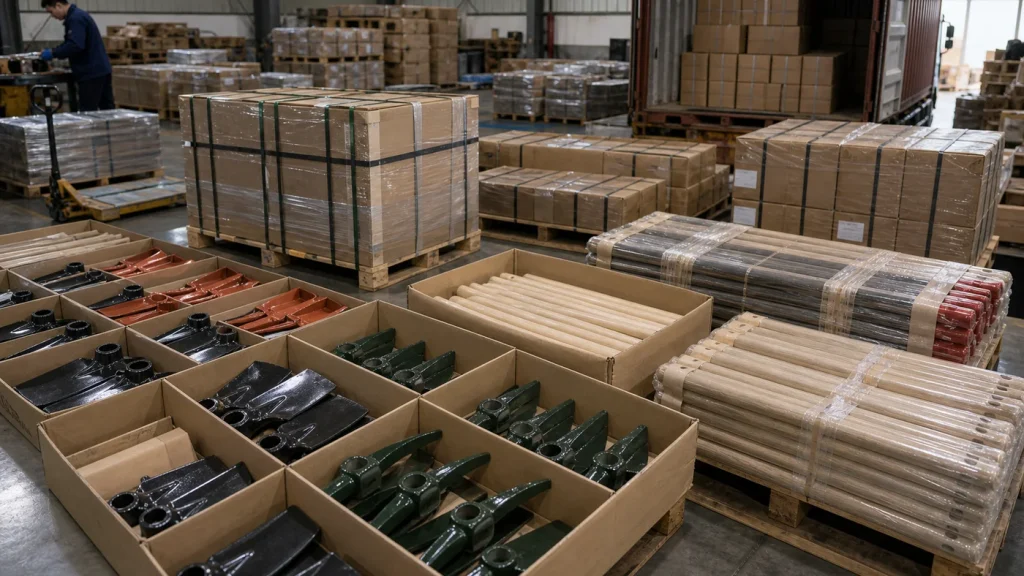
For mixed containers, heavy digging tools should be planned carefully with lighter hardware products. Carton weight, pallet height, loading position, and unloading sequence all matter. A strong packing plan reduces damage and helps the receiving warehouse sort models quickly.
Retail and wholesale channels need different assortment logic
A farm wholesale buyer may need a small number of durable, practical models in strong cartons. A garden center may need lighter tools with cleaner finish and retail-friendly handles. A construction distributor may need heavier pickaxes and mattocks with dependable impact strength. These channels should not be forced into the same product mix.
Importers can build the assortment by separating head-only items, complete handled tools, heavy-duty digging tools, light garden tools, and retail display items. Each group should have its own price level, specification, and packing method.
This makes quotations clearer. Suppliers can quote accurately when the buyer specifies whether the product is for field work, retail shelves, construction channels, or local assembly. It also prevents buyers from comparing offers that look similar but are built to different standards.
A practical order sheet reduces repeat problems
A strong order sheet should include product type, head shape, head weight, weight tolerance, material reference, heat-treatment expectation, eye size, eye angle, handle material, handle length, handle diameter, finish, packing method, carton quantity, carton weight, pallet plan, and inspection points.
The buyer should define which points are critical. For a heavy pickaxe, eye strength and handle fit may be more important than perfect surface gloss. For a retail garden hoe, finish, barcode position, and clean packing may carry more weight. For local assembly, eye consistency and handle dimensions are critical.
When these details are written before production, the importer has a stronger basis for supplier comparison, inspection, and repeat ordering. The goal is not to create unnecessary paperwork. The goal is to make sure the product arriving at the warehouse is the product the market can actually sell and use.
Hoes and pickaxes work well in planned hardware programs
Hoes and pickaxes can strengthen a hardware sourcing program because they are practical, familiar, and useful across agricultural, construction, garden, and rural retail channels. They can also combine with other hardware categories when the buyer wants a balanced mixed container.
The category performs best when importers control the details that users notice in the field: head weight, balance, eye fit, handle security, edge condition, coating, and packing. These points decide whether a simple tool becomes a repeat seller or a claim risk.
For buyers building a dependable hardware range, hoes and pickaxes should be sourced as working tools with clear user scenarios. A clear specification, practical inspection, and realistic packing plan make the category easier to buy, easier to receive, and easier to reorder.