
Machetes and sickles are common agricultural cutting tools, but they are not simple commodity items for importers. A buyer can receive two tools with the same length and similar appearance, yet the real performance may differ because of blade steel, heat treatment, edge geometry, handle fitting, surface finish, packing, and batch consistency.
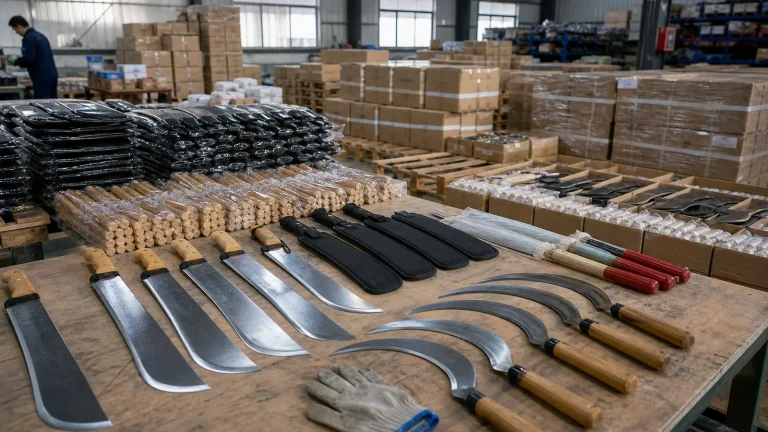
For farm supply distributors, rural retail chains, garden channels, hardware wholesalers, and mixed container buyers, these tools often serve practical users who judge the product quickly in the field. If the blade bends too easily, chips, rusts, loosens at the handle, or arrives with damaged packaging, the importer may face returns and weak repeat orders.
The right sourcing method is to treat machetes and sickles as working tools with clear use cases. Cane cutting, brush clearing, grass cutting, rice harvesting, garden trimming, and farm retail programs may need different blade shapes, thickness, edge style, handle material, sleeve design, and packing method.
Start with the work scenario, not only the model shape
The first sourcing question should be where the tool will be used. A machete for brush clearing does not need the same balance as a lighter garden machete. A serrated rice sickle has a different cutting behavior from a smooth-edge harvesting sickle. A retail garden sickle may need cleaner packaging and lighter handling than a farm wholesale item packed for bulk distribution.
Importers should define the main use scenario before selecting SKUs. Useful details include target crop or vegetation, expected blade length, cutting motion, user preference for weight, handle grip style, packaging type, and whether the product is sold through retail shelves, farm stores, distributors, or local assembly channels.
This prevents a common problem: buying a tool that looks close to the sample but does not fit the actual customer. For cutting tools, shape alone is not enough. The blade must match the work, and the packing must match the sales channel.
Blade steel and thickness affect both cost and field performance
Blade steel selection should be linked to the intended use and price level. Buyers may compare carbon steel, heat-treated steel, stainless options in limited cases, or other agreed material specifications depending on the market. The key is not to use a vague steel description without performance expectations.
Thickness is equally important. A blade that is too thin may feel light and cheap but can bend or vibrate during harder work. A blade that is too thick may increase cost, weight, and shipping burden without improving the user experience for lighter applications. For sickles, blade thickness and curvature influence control and cutting feel.
Importers should define thickness tolerance, blade length, blade width, curvature, tip shape, and weight range where relevant. If the buyer sells several grades, these details should separate economy, standard, and stronger field-use items rather than leaving each supplier to decide.
Heat treatment and hardness need practical control
Heat treatment is one of the most important hidden factors in agricultural cutting tools. If the blade is too soft, the edge may roll or dull too quickly. If it is too hard or brittle, the edge may chip under impact. The buyer needs a practical hardness target or agreed performance test that matches the product grade and working scenario.
For machetes, the blade may need a balance between flexibility and edge retention. For sickles, edge sharpness, tooth condition on serrated models, and resistance to deformation are important. Importers should not rely only on a polished sample. Batch testing is needed because heat treatment can vary across production lots.
A reasonable order file can include material reference, hardness range if applicable, heat-treatment expectation, edge retention expectation, bending tolerance, and sample approval notes. The goal is not to overcomplicate the order, but to make sure the supplier understands what kind of working tool the buyer is purchasing.
Edge geometry is a product decision
The edge controls how the tool enters the material. A machete edge for brush and branch clearing may need a different bevel from a light garden machete. A sickle may use a smooth edge, serrated edge, or specialized tooth pattern depending on the crop or cutting style. These differences affect cutting speed, safety, sharpening, and user satisfaction.
Buyers should confirm edge angle, sharpened area, serration pattern, tip condition, and whether the edge is shipped fully sharpened or semi-finished according to market expectations. Some channels prefer a ready-to-use sharp edge, while others prioritize safer handling and local finishing.
Edge consistency should be checked across the shipment. A good sample does not prove that every carton will have the same edge finish. For retail products, edge appearance also matters because users inspect the tool before purchase.
Handle design must be matched with blade force
The handle is not just a decoration. It carries impact, grip pressure, moisture exposure, and repeated motion. Machetes may use wood, plastic, rubberized, or composite handle options. Sickles often use wood or plastic handles, and the attachment method can vary by model.
Importers should check handle material, shape, grip comfort, rivet or fastener quality, tang length, handle coating, surface smoothness, and fit between blade and handle. Loose handles are one of the fastest ways to damage buyer trust because the problem appears during normal use.
The handle should also match the market. A farm wholesale buyer may prefer durable and simple construction. A garden retail buyer may value a smoother grip and cleaner finish. A private-label program may need color control, label position, barcode space, and consistent retail display packing.
Quality control should test the tool as a working item
Inspection should go beyond counting cartons and checking surface appearance. Machetes and sickles need checks for blade length, thickness, weight, curvature, edge condition, tip condition, handle fit, rivet strength, surface finish, sleeve fit, carton condition, and batch consistency.
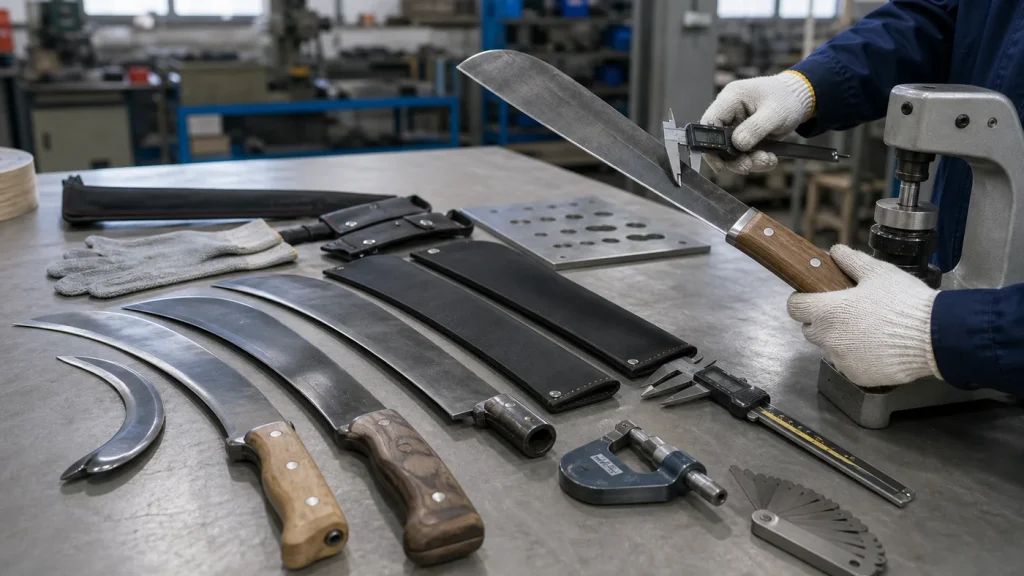
For selected batches, buyers can request basic functional checks such as edge inspection, handle pull or movement checks, bending observation within agreed limits, and sample cutting tests against the intended use. The exact test should match the product and market rather than becoming a generic checklist.
Inspection records should identify which cartons or batches were checked. This is important for repeat orders because the buyer can compare future shipments against the approved benchmark and detect supplier drift before customers complain.
Surface finish and rust prevention protect first impression
Many agricultural cutting tools are exposed to moisture during transport, storage, and use. Surface finish and rust protection should be part of the order discussion. Options may include oiling, black finish, painted finish, polished finish, clear coating, protective sleeves, or other agreed treatments depending on the product and market.
The buyer should define acceptable surface marks, coating coverage, edge cleanliness, oil level, and storage protection. Too much oil may create a poor retail experience, while too little protection may create rust claims after sea freight or warehouse storage. For retail packs, visible stains on sleeves or cartons can also hurt shelf appeal.
If the destination market has humid storage conditions or long transit times, the packing plan should include moisture control and carton protection. Rust prevention should be planned before loading, not after the buyer sees photos of damaged goods.
Safe packing is part of product quality
Machetes and sickles are sharp tools, so packing must protect both the blade and the people who handle the shipment. A low-cost carton plan can become expensive if blades cut sleeves, damage cartons, injure warehouse workers, or arrive with scratched surfaces.
Useful packing controls may include blade sleeves, tip protection, individual polybags, paper wrapping, blister cards, retail sleeves, inner boxes, carton dividers, bundle separation, stronger master cartons, pallet wrapping, and clear SKU separation. The right combination depends on whether the tools are for bulk wholesale, farm stores, garden retail, or private-label programs.
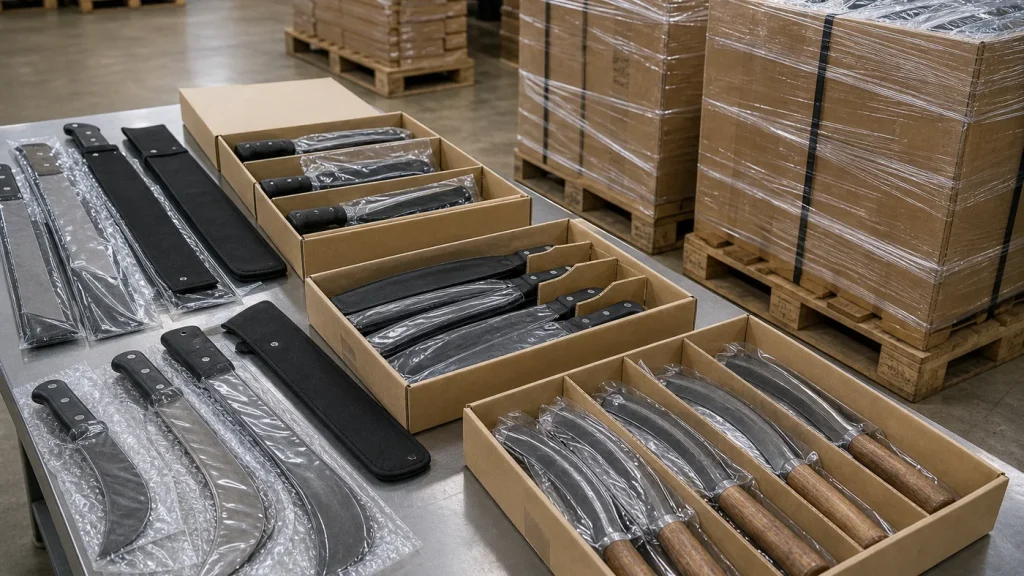
For mixed containers, sharp tools should not be packed loosely beside products that can be punctured or scratched. Carton position, pallet stability, and receiving sequence should be considered when the shipment includes other hardware products.
Retail packaging and bulk packing need different logic
A retail pack must help the buyer sell the item. It may need a sleeve, hang hole, barcode, size marking, safety warning, product photo, or brand label. A bulk farm supply pack may focus on protection, carton strength, and easy warehouse counting. The importer should not use one packing plan for every sales channel.
Private-label orders need extra control over artwork approval, label placement, carton marks, barcode accuracy, and safety information. Even when no private label is used, the carton should clearly separate model, size, quantity, and destination requirements.
Packaging should be checked before mass production. A good tool packed in a weak sleeve can still create claims. A strong sleeve with confusing size marks can still create warehouse errors. Packing is part of the product, not a final afterthought.
Build the assortment around real buyer channels
A strong machete and sickle program does not need too many similar SKUs at the beginning. Importers can build a focused range by separating heavy field-use machetes, lighter garden machetes, smooth-edge sickles, serrated sickles, and retail-ready options. Each group should have a clear reason to exist.
For farm supply distributors, durability, replacement demand, carton strength, and practical pricing may matter most. For garden retail channels, appearance, handle comfort, safe packaging, and shelf presentation can matter more. For mixed hardware buyers, MOQ, carton size, loading efficiency, and SKU separation become important.
This channel-based planning reduces inventory confusion. It also helps suppliers quote more accurately because the buyer is not asking for a generic machete or sickle, but for a defined product program.
A clear order sheet reduces claims
A practical order sheet for machetes and sickles should include product type, blade shape, blade length, thickness, material reference, heat-treatment expectation, edge style, handle material, handle attachment method, surface finish, sleeve type, packaging method, carton quantity, inspection points, and destination market notes.
The buyer should also define which points are critical. For example, a field-use machete may prioritize blade strength and handle attachment. A retail sickle may prioritize edge consistency, sleeve safety, and clean packaging. A private-label order may prioritize artwork approval and pack uniformity.
When these details are controlled, importers can compare supplier offers more realistically. The cheapest quotation may not include the same blade thickness, heat treatment, sleeve quality, carton strength, or inspection control as a better offer.
Machetes and sickles can be dependable repeat categories
Machetes and sickles remain useful categories because they serve farming, gardening, brush clearing, harvesting, rural retail, and hardware distribution. They can also fit well into broader hardware sourcing programs when the buyer needs practical, repeat-demand items instead of one-time novelty products.
The sourcing challenge is that these tools look simple while the real quality sits in details. Blade steel, heat treatment, edge geometry, handle strength, surface protection, and safe packing all affect the final result. If importers control these points early, the category becomes easier to reorder and easier to sell.
For buyers building a hardware tool range, the best approach is to connect the product to the user. A machete or sickle should be selected for the work it performs, the channel that sells it, and the packing route that protects it. That is how a common agricultural tool becomes a reliable sourcing item.