
A mixed hardware container is not just a container with many products inside. For importers, wholesalers, distributors, and retail chains, it should be a planned buying structure: the right SKUs, the right quantities, the right packaging, and a loading plan that makes the freight cost work.
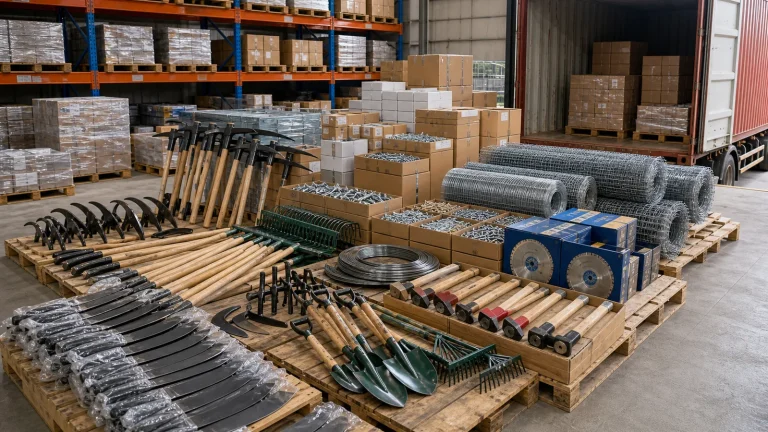
This planning work is especially important in hardware because the product range is naturally broad. One buyer may need machetes, sickles, hoes, shovel blades, shovels, pickaxes, forks, rakes, axes, hammers, wire mesh, nails, fasteners, diamond blades, and selected steel products. Each category has different weight, volume, MOQ, packaging, and inspection requirements.
If these items are purchased separately without a container-level plan, the order can become expensive and difficult to control. The buyer may over-order one slow-moving item, under-order fast-moving support products, or pay too much domestic handling cost before the goods even reach the port.
Start with sales-channel logic, not only product lists
The first question is not “How many products can fit?” The better question is “Which product mix supports the buyer’s sales channel?” A farm supply distributor, a construction hardware wholesaler, a retail chain, and an ecommerce seller do not need the same container.
A farm supply buyer may focus on agricultural cutting and digging tools: cane machetes, Latin-pattern machetes, serrated rice sickles, Japanese garden sickles, steel hoes, shovel blades, pickaxe heads, forks, and rakes. A construction hardware buyer may give more space to wire mesh, nails, fasteners, diamond blades, hammers, and selected steel strip or sheet products. A retail buyer may need cleaner packaging, smaller cartons, balanced assortment, and shelf-ready labels.
When the container starts from channel logic, the SKU list becomes more disciplined. Each item has a job: core sales volume, seasonal demand, category support, margin improvement, or market testing.
Build the SKU mix in product families
Hardware buyers often lose control when every item is treated as a separate decision. A better method is to plan by product family first, then select individual SKUs inside each family.
For agricultural and garden tools, the family may include machetes, sickles, hoes, shovel blades, shovels, pickaxes, forks, rakes, axes, and hammers. These products often share buyer channels, but they do not share the same packing style or loading behavior. Long-handle tools use more cubic space. Head-only items such as hoe heads, pickaxe heads, and shovel blades are denser and easier to stack, but they add weight quickly.
For hardware supplies, the family may include galvanized wire mesh rolls, welded wire mesh panels, hexagonal wire netting, binding wire, common nails, concrete nails, roofing nails, coil nails, fasteners, and diamond cutting blades. These products support contractors and hardware stores, but their packing and damage risk are different. Mesh rolls need shape protection. Nails and fasteners need strong cartons or bags. Diamond blades need clear size separation and carton marking.
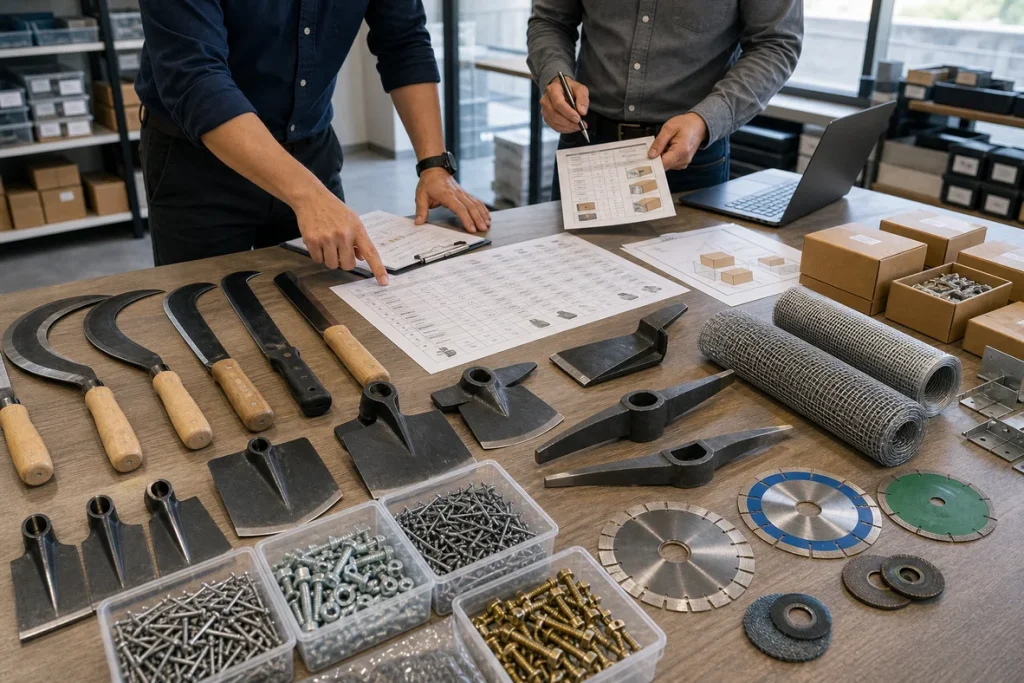
Once the buyer has product families, the next step is to decide the role of each SKU. A few SKUs should be volume drivers. Some should be supporting products that make the catalog more complete. A small number can be trial items for new markets. This keeps the container useful without turning it into a random sample shipment.
Control MOQ before confirming the final mix
MOQ control is where many mixed hardware orders become difficult. Different factories and product lines may have different minimum production quantities. Some items may require a full production batch. Others may be available from regular stock or semi-finished material. Packaging customization can also raise the real MOQ beyond the product MOQ.
Before confirming the container, the buyer should separate SKUs into three groups. The first group is stable repeat items that can accept higher quantities. The second group is supporting items that need moderate quantities. The third group is trial items that should stay small until the market proves demand.
This structure helps avoid the common mistake of giving every SKU the same importance. For example, a distributor may order higher quantities of common hoe models, popular shovel blades, standard nails, or fast-moving wire mesh sizes, while keeping special machete styles, uncommon rake models, or new diamond blade specifications at a trial level.
MOQ control should also be reviewed against carton quantity. If one carton holds 24 pieces, ordering 1,000 pieces may create broken cartons or awkward warehouse counting. Clean carton math improves receiving, storage, and resale.
Balance heavy goods with bulky goods
A mixed hardware container should be planned by both weight and cubic volume. Many hardware products are metal-heavy, so the container can reach weight limits before the space is full. Other products, especially long-handle tools, boxed retail items, and some mesh formats, may fill space faster than expected.
This is why the product mix matters. Nails, fasteners, steel products, tool heads, and dense metal components can make the container too heavy. Long-handle shovels, rakes, hoes, axes, hammers, and mesh rolls can use more space. A workable plan usually combines dense cargo with bulkier cargo so neither weight nor volume is wasted.
The loading plan should also consider damage risk. Heavy cartons should not crush retail packaging or delicate boxed accessories. Sharp tools and blades need secure wrapping. Mesh rolls and panels need stable stacking. Diamond blades should be kept dry, clearly marked, and separated by size or rim type when needed.
Confirm samples, packaging, and carton marks early
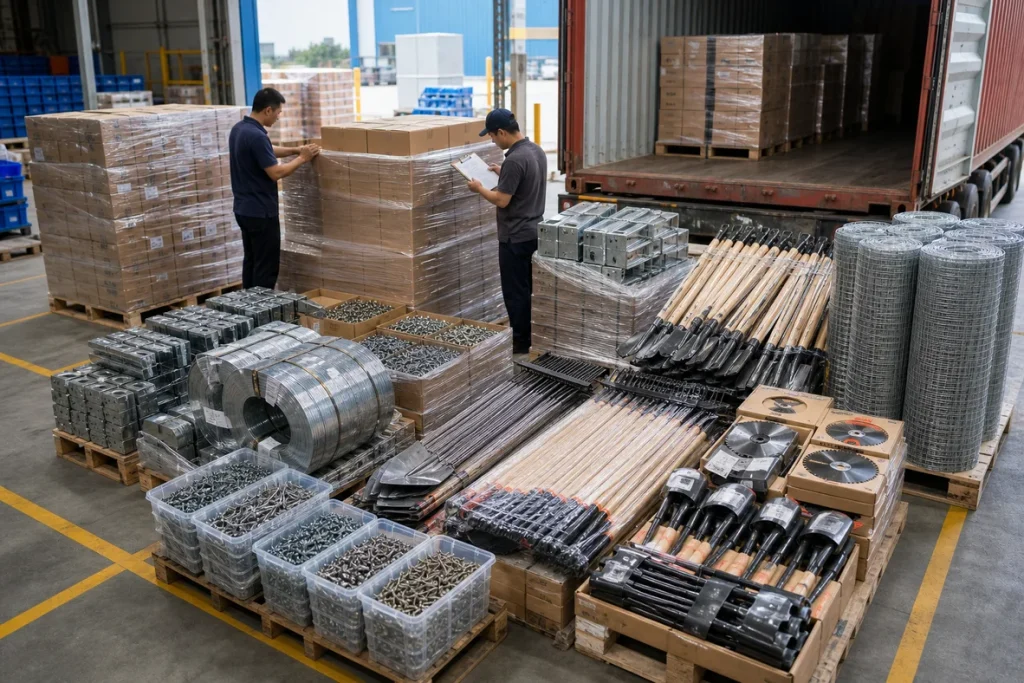
For mixed hardware procurement, sample approval is not only about product appearance. The buyer should also confirm material, thickness, weight, handle type, finish, blade edge, weld quality, carton strength, label content, and carton marks. A small difference in specification can change the real value of the item.
Packaging should be checked before production. Agricultural tools may need rust protection, edge protection, bundle packing, or branded labels. Wire mesh and steel products may need moisture control and stronger wrapping. Nails and fasteners need cartons that can handle dense weight. Diamond blades need size labels that are easy to read in the warehouse.
Carton marks matter because mixed containers contain many SKUs. If marks are unclear, the destination warehouse spends more time sorting products after arrival. SKU code, item name, specification, quantity, gross weight, net weight, carton number, and destination information should be consistent across the order.
Use inspection checkpoints before loading
A mixed container needs inspection discipline. The buyer should not only inspect one product family and assume the rest is acceptable. Each major product group should have its own checkpoint: quantity, visual finish, dimensions, weight, packing, carton strength, labels, and safety handling.
For cutting tools such as machetes and sickles, edge consistency, blade thickness, handle fitting, rust prevention, and packing safety are important. For digging tools such as hoes, shovel blades, and pickaxes, steel thickness, heat treatment, socket fit, paint or coating, and carton or bundle strength should be checked. For wire mesh, nails, fasteners, steel products, and diamond blades, specification accuracy and packing integrity are essential.
Final loading should connect the inspection result with the container plan. The team should know what is loaded first, what must stay on top, what needs separation, and which cartons or pallets must be easy to identify at arrival.
A practical mixed container is built before the goods move
The best mixed hardware container is built on paper before the warehouse starts loading. SKU selection, MOQ control, packaging, weight balance, volume use, carton marks, and inspection timing all need to work together.
For hardware buyers, this planning process reduces three risks at the same time: buying too much of one item, wasting freight space, and receiving a shipment that is hard to sort or sell. A well-planned container can carry a broader product range while keeping the order manageable.
That is the practical value of mixed hardware procurement. It gives buyers a way to combine agricultural tools, garden tools, hardware supplies, steel products, and cutting accessories into one more efficient export shipment without losing control of quality, quantity, or landed cost.