
Buying bare shovel blades is different from buying a finished shovel. The buyer is not only selecting a steel head; they are defining an interface between the blade, the handle, the assembly method, the sales channel, and the way the shipment will be packed. For importers, distributors, agricultural-supply wholesalers, and regional assemblers, a bare-blade program can reduce freight volume, allow local handle choices, and make it easier to offer a range of handle lengths or materials. It also creates a clear responsibility: the blade and handle must fit consistently when they meet at the assembly line.
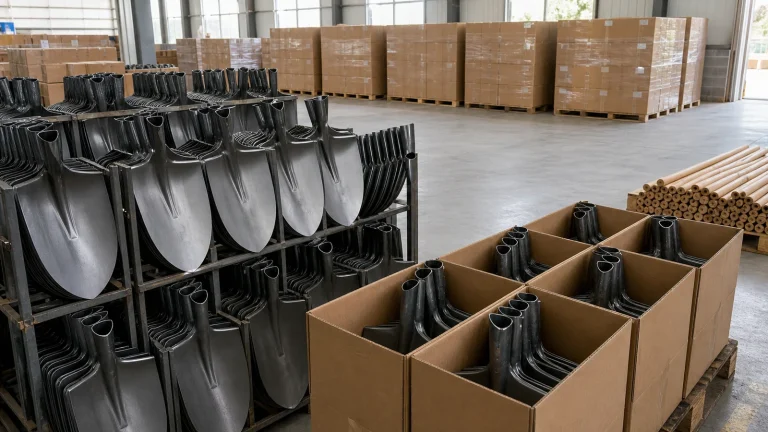
A quotation for “shovel heads” is not enough. Similar-looking blades can differ in shape, bowl depth, shoulder form, socket diameter, socket depth, strap design, wall thickness, coating, edge finish, and nesting method. Each difference affects assembly, feel, durability, carton quantity, and the number of pieces that can be handled safely in a container. The order should turn the intended local product into measurable details before production begins.
This guide focuses on bare blades that will receive a handle later. A complete long-handle tool is a separate sourcing decision because it introduces different risks around handle species, moisture, grip, finished-tool alignment, retail presentation, and overall length. Keeping the bare blade specification clear gives the buyer more control over where and how final assembly happens.
Start with the job the finished shovel must do
Blade pattern should follow the material and work the finished shovel is expected to handle. A pointed form, a broader square form, a deeper bowl, or a flatter blade can serve different digging, lifting, loading, or site-maintenance uses. The buyer does not need to prescribe one universal pattern; the buyer needs to state the target work, destination channel, and approved sample so the blade profile is chosen deliberately.
Record the overall blade length and width, usable bowl shape, shoulder profile, edge condition, and whether a foot-contact area or reinforced transition is required for the selected model. These dimensions should be confirmed with a drawing or retained sample, especially when a program includes more than one blade shape. Product names vary by market, so measurements and photographs prevent a local trade name from being interpreted differently by the factory and the receiving team.
Think about who will sell and use the finished shovel. Agricultural dealers may want familiar patterns that local users already recognize. Municipal, construction, or garden channels may prefer a different balance of blade size and handle length. Retail buyers can also care about visible symmetry and coating appearance. A sourcing brief that starts with the final job produces a more useful blade range than one assembled only from factory stock items.
Specify thickness and formed shape as separate controls
Nominal steel thickness is an essential order detail, but it is not the whole description of a blade. Pressing and forming create the bowl, ribs, shoulders, and socket transition that give the blade its final geometry. A blade can meet a quoted thickness and still be unsatisfactory if the formed profile is uneven, the socket transition is distorted, or the blade does not sit square during assembly.
The order sheet should state the nominal thickness, the locations where it will be checked, and an agreed tolerance. It should also identify any area where a different forming treatment or reinforcement is expected. Inspection should compare the blade to the approved sample for symmetry, consistent bowl depth, smooth edges, visible cracks, sharp burrs, dents, and local thinning around the socket or shoulder. Avoid accepting a generic “heavy duty” claim in place of a measurable requirement.
Weight is a useful supporting check, but it should not replace dimensional inspection. A buyer can record a target piece weight or acceptable range to help detect material variation across a batch. That record must be interpreted together with blade dimensions and the actual shape. A heavier blade is not automatically a better blade if it no longer matches the intended handling or assembly program.
The socket and handle interface deserve a dedicated specification
For a bare-blade program, the socket is the connection that matters most. The diameter, internal shape, depth, angle, seam or reinforcement construction, and fastening-hole position must work with the handle the assembler intends to use. A handle that is too loose can move during use; one that is too tight may split, require excessive rework, or prevent consistent insertion. A socket that sits at the wrong angle can make the completed tool feel awkward even when the blade itself looks correct.
Send the blade supplier a physical handle sample, a controlled drawing, or both. The supplier should return a fitted blade-and-handle sample before bulk production. The sample needs to show insertion depth, straightness, hole alignment where applicable, and the condition of the handle after fitting. The buyer should also define whether handles will be secured by a fastener, wedge, adhesive, or another local assembly method, because that choice influences the required socket details.
Do not assume that wooden, fiberglass, steel, and composite handles are interchangeable. Their outer dimensions, taper, wall behavior, and assembly process can differ. If more than one handle type will be sold, treat each interface as a separate approved combination. This is particularly important when the blade is shipped to one warehouse while handles are obtained from a different source.
Choose a finish for transport, storage, and the intended market
Coating and surface finish affect appearance, temporary corrosion protection, handling, and how the product will look after local assembly. The buyer should state the accepted finish direction rather than using broad language such as “painted” or “black finish.” Confirm color where it matters, coverage on the blade and socket, visible bare areas, adhesion expectations, and whether minor handling marks are acceptable.
Surface protection should be planned with the actual route in mind. Bare blades can spend time in factory storage, consolidation, sea freight, inland transport, and local warehousing before a handle is fitted. Moisture, abrasion between nested pieces, torn packaging, and wet cartons can all affect the delivered appearance. The finish, protective separators, moisture control, and unloading plan should support the time the goods will remain unassembled.
Inspectors should look for uneven coverage, flaking, obvious runs, rust spots, scratches that expose large areas of steel, and coating build-up that interferes with the socket. The standard should be realistic for an industrial tool component while still protecting the buyer from inconsistent batches. An approved sample remains the best reference for this balance.
Check fit, dimensions, and consistency before the blades are packed
A practical inspection should begin with product identity: correct blade pattern, approved finish, and correct socket version. It should then measure blade length and width, thickness at agreed points, socket opening, socket depth, insertion angle, relevant hole position, and piece weight. Inspectors should select samples across different production times, cartons, and pallet positions rather than relying on a small group chosen at the start of the run.
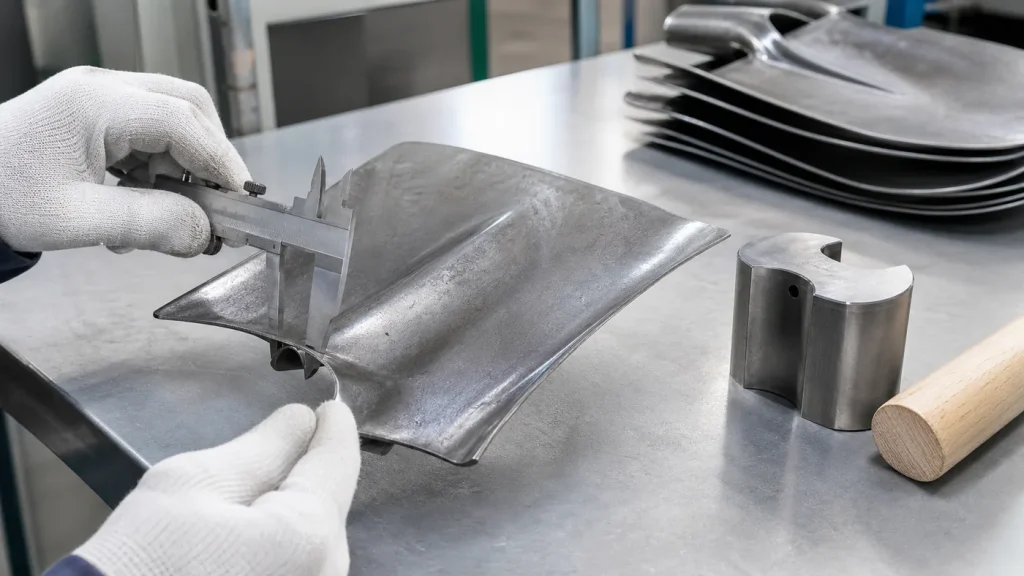
Include a functional fit check. Use the approved handle sample to confirm insertion depth and alignment, then inspect the blade and handle for damage caused by fitting. The goal is not to assemble every blade at the factory. The goal is to prove that the agreed socket can be assembled consistently in the destination market with normal local equipment and process control.
Photos and measurement records should identify the exact model and production batch. This creates a useful reference for repeat orders and allows the buyer to distinguish a genuine specification change from a normal cosmetic variation. It also gives the local assembly team a clear receiving checklist.
Nesting and separate handle packing can improve the container plan
Bare shovel blades are often shipped nested so that the blade bowls occupy less space than completed tools. This can be a strong logistics advantage, but nesting must not damage edges, coatings, or sockets. The packing plan should state the pieces per nested bundle, separator material, edge protection, bundle restraint, carton or pallet configuration, gross weight, and safe lifting method.
Handles should normally be packed separately and protected against moisture, bending, staining, and transit abrasion. Keeping blades and handles separate can simplify local assembly, but the receiving warehouse still needs a clear count system so the correct number of handles is available for each blade model. Do not create a container that looks full but contains an unbalanced mix of blades and handles.
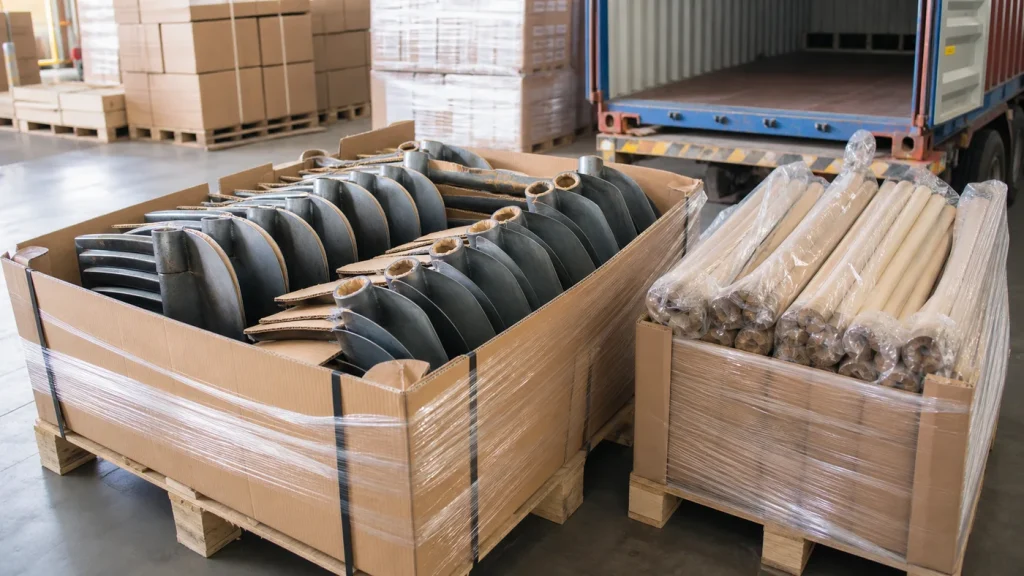
Container planning should also consider weight distribution. Steel blades are dense, while wooden handles occupy comparatively more volume. A buyer can use that difference to build a practical shipment, but only after confirming gross weight, pallet loading, container floor limits, and the unloading method at destination. A low freight cost per component is not useful if cartons are crushed or the warehouse cannot receive the load safely.
Build the SKU range around local assembly and sales channels
A distributor does not always need every blade pattern offered by a factory. A focused range of fast-moving shapes, socket sizes, and finishes is easier to assemble, stock, inspect, and reorder. The assortment should follow the handles that are reliably available locally and the applications customers actually request.
For example, the buyer may decide to standardize one socket family across several blade patterns so one local handle program can serve multiple SKUs. That can simplify handle purchasing and assembly fixtures. The decision still needs sample confirmation: a common handle size does not remove the need to validate the angle and insertion depth of each blade model.
Retail and wholesale channels may need different component programs. A local assembler supplying dealers may prioritize bulk pallet quantities and repeatable sockets. A retail program may need finished-tool presentation, exact handle length, and packaging that is applied after assembly. Defining the channel early prevents the buyer from importing a blade that is technically usable but commercially awkward.
Use an order sheet that connects blade production to final assembly
A complete order sheet should include the blade pattern and approved drawing or sample, blade length and width, nominal thickness and tolerance, target weight range, socket internal dimensions and depth, socket angle, hole position if used, finish, edge condition, accepted cosmetic standard, handle sample or drawing reference, local fastening method, nesting quantity, separators, carton and pallet requirements, marks, and inspection points.
The sheet should also name the critical checks for the destination assembler: handle insertion depth, alignment, socket fit, count balance between blades and handles, and protection against moisture before assembly. When these details are documented, suppliers quote on the same basis, inspectors know what to measure, and the warehouse receives components that can move into assembly without improvised rework.
Successful shovel blade sourcing is not about choosing the cheapest stamped head. It is about creating a reliable component program: a blade shape that suits the market, controlled thickness and forming, a socket that fits the local handle, a finish that survives the route, protected nesting, and evidence that the final assembly will work. That is what makes a bare-blade shipment a practical starting point for a repeatable local tool line.