
For many hardware importers, garden-tool and agricultural-tool sourcing starts with a practical question: should the order focus on tool heads, complete long-handle tools, or a combination of both? The answer affects container use, MOQ, local assembly, packaging, retail presentation, and after-arrival handling.
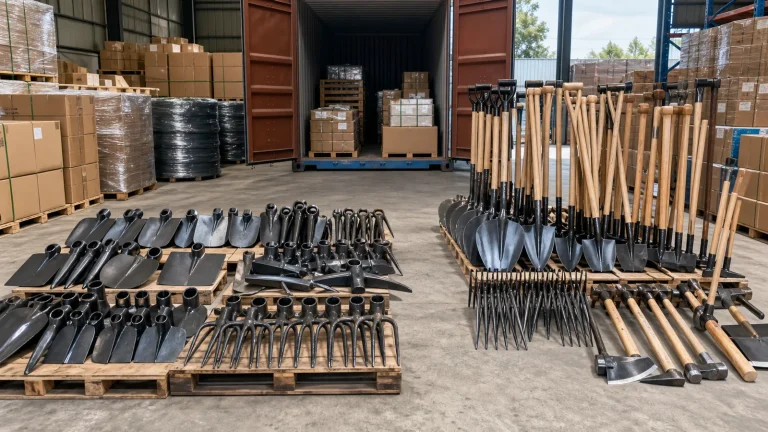
Tool heads include items such as hoe heads, shovel blades, pickaxe heads, fork heads, rake heads, mattock heads, axe heads, and other metal working parts without the final handle assembled. Complete long-handle tools include assembled shovels, hoes, rakes, forks, pickaxes, axes, hammers, and related garden or agricultural tools ready for sale or use.
Both formats can be correct. The stronger sourcing plan depends on the buyer channel, destination market, labor cost, handle availability, warehouse capacity, packaging requirement, and the way products are sold after arrival.
Why tool heads are attractive for importers
Tool heads are compact. A container can hold more units because the shipment is mostly dense metal parts rather than long assembled tools. For buyers facing high ocean freight cost, this can make a major difference in landed cost per unit.
They also give importers flexibility. A distributor can import popular hoe heads, shovel blades, pickaxe heads, or rake heads in larger quantities, then assemble with local wooden, fiberglass, or steel handles depending on local customer preference. This is useful when handle length, wood species, grip style, or local retail habit varies by region.
Tool heads also reduce some damage risk during ocean shipping. Long handles can bend, crack, shift, or require special bundling. Metal heads still need rust protection, coating checks, and strong cartons, but they are easier to stack and count when the packing plan is disciplined.
Where complete tools work better
Complete long-handle tools are easier to sell immediately. Retailers, farm stores, project buyers, and some wholesalers do not want to arrange local assembly. They need products that can move from receiving warehouse to shelf, contractor supply, or project site without extra processing.
Complete tools are also stronger when packaging and presentation matter. A retail-ready shovel, hoe, rake, or axe can carry a hang tag, sleeve, barcode label, handle finish, grip color, and a more complete product identity. For retail chains and ecommerce sellers, this matters because the product is judged as a finished item, not only a metal component.
The tradeoff is logistics. Long-handle tools use more cubic space, and the packing shape can be awkward. Bundles must be controlled so handles do not shift inside the container. Carton or crate design must protect both the head and the handle. A buyer may receive a cleaner retail product, but the container may carry fewer total units.
Start from the buyer channel
The right product mix should start with the buyer channel rather than factory convenience. A regional agricultural distributor may prefer more tool heads because local assembly is normal and customers already expect replacement heads or locally handled tools. A farm supply store may want both: bulk hoe heads and shovel blades for trade buyers, plus complete tools for walk-in retail sales.
A construction and hardware wholesaler may use complete shovels, pickaxes, hammers, and rakes as standard stock, while also importing heads for lower-cost replenishment. A retail chain may lean toward complete tools because each product must be ready for shelf display, scanning, and consumer comparison.
For new importers, a mixed approach is often the safest. Tool heads can carry the volume, while a smaller selection of complete tools can test retail demand, handle preferences, and packaging expectations.
Compare weight, volume, and container behavior
Tool heads are dense. Hoe heads, shovel blades, pickaxe heads, fork heads, and rake heads can make a container heavy before the cubic space is fully used. Complete tools are usually more volume-heavy because the handle length determines packing shape and pallet behavior.
This difference is useful when planning a mixed container. Dense tool-head cartons can be combined with bulkier complete shovels, hoes, rakes, and hammers. The goal is not simply to add more SKUs. The goal is to use both weight allowance and container volume in a controlled way.
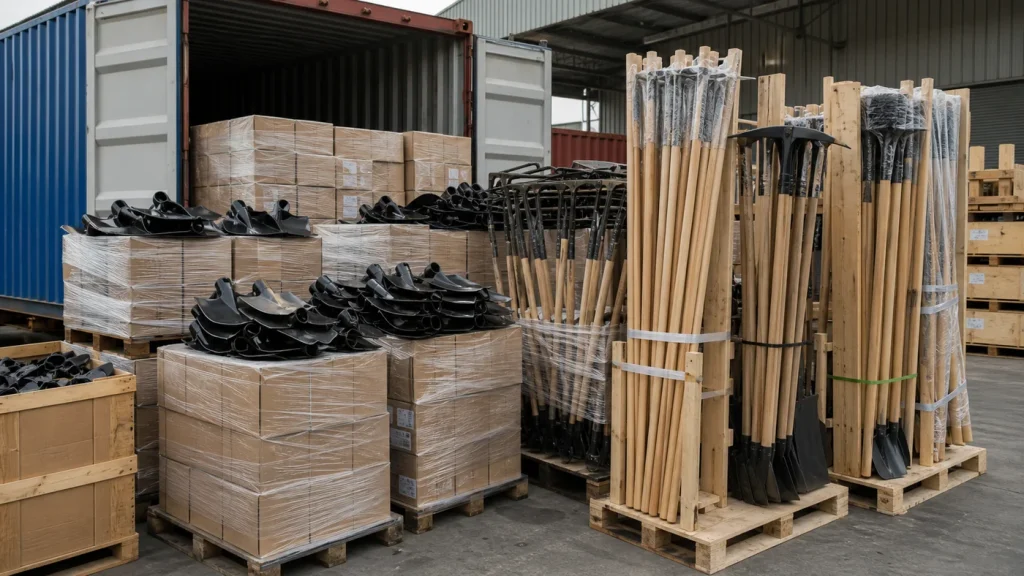
Loading sequence also matters. Heavy cartons of metal heads should be placed where they do not crush complete-tool packaging. Long-handle tools should be bundled, strapped, and supported so the heads do not damage neighboring cartons. If crates are used, their dimensions should be matched to the container plan before production is finished.
Handle sourcing changes the decision
The handle is often the reason a buyer chooses one format over the other. In some markets, local wooden handles are common, low-cost, and preferred by end users. In that case, importing metal heads may be more practical than importing full assembled tools.
In other markets, buyers want a consistent handle specification from the supplier: ash, beech, eucalyptus, fiberglass, steel tube, plastic grip, varnished wood, painted handle, or a specific length. For those buyers, complete tools give more control over final product appearance and user experience.
Importers should compare not only the purchase price, but the full handling cost after arrival. Local handle sourcing, assembly labor, storage space, rejected handles, missing parts, and packaging work can reduce the apparent saving from buying only heads. The best decision depends on the buyer’s own operating model.
MOQ control is easier when the roles are clear
Tool heads and complete tools should not be ordered with the same logic. Tool heads are often better for repeat-volume items: common hoe heads, standard shovel blades, pickaxe heads, and basic rake or fork heads. Complete tools are often better for retail-ready SKUs, trial styles, and products where handle finish is part of the value.
A practical order may place higher quantities on stable metal heads and smaller quantities on complete tools. This gives the buyer enough stock for trade demand while limiting risk on handle style, packaging, or retail presentation.
Carton quantity should also be checked early. Tool heads may be packed by dozens or by weight-controlled carton sizes. Complete tools may be packed in bundles, cartons, or crates. Clean carton math makes receiving and warehouse counting easier after arrival.
Inspection should separate head quality and handle quality
For tool heads, inspection should focus on steel thickness, socket shape, welding or forming quality, heat treatment where relevant, blade edge, coating, paint adhesion, rust prevention, and carton strength. A small difference in socket size can create assembly problems later.
For complete tools, the inspection scope is broader. The buyer needs to check head quality plus handle length, straightness, moisture level, finish, connection strength, grip condition, label position, retail packaging, and bundle protection. If the product is sold directly to consumers, appearance consistency matters more.
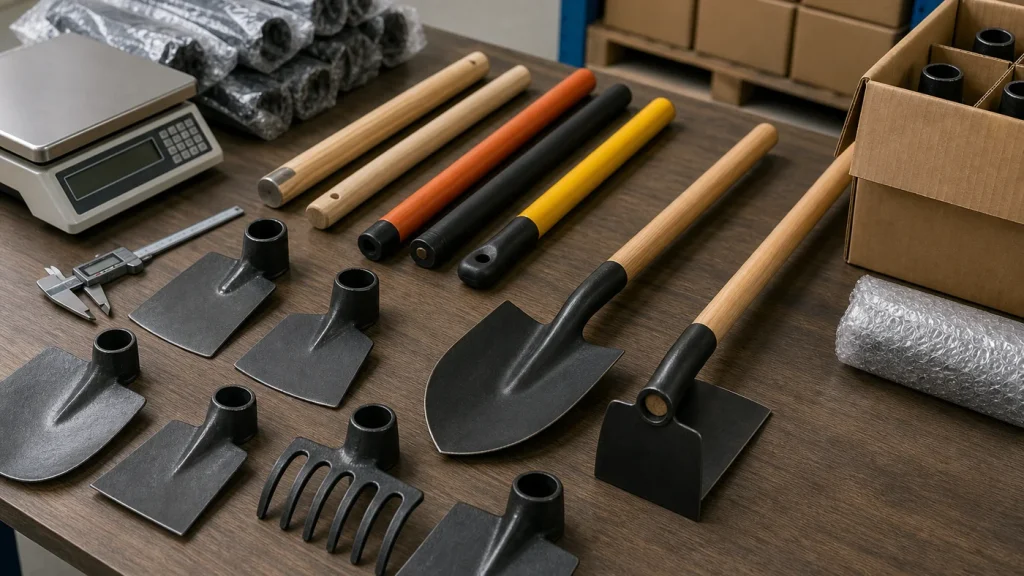
Sample approval should therefore include both formats when the order mixes them. A buyer may approve a strong hoe head but still reject the handle length or finish on the complete version. Separating these checkpoints helps avoid late production disputes.
A better product mix uses both formats deliberately
The strongest sourcing plan is rarely “all heads” or “all complete tools.” For many importers, the best answer is a deliberate mix. Tool heads can improve container efficiency and give flexibility for local assembly. Complete tools can support retail sales, project delivery, and immediate market testing.
A practical mixed order might include higher-volume hoe heads, shovel blades, and pickaxe heads, plus selected complete shovels, hoes, rakes, axes, and hammers. The mix should reflect channel demand, container balance, MOQ, handle availability, and the buyer’s warehouse process.
For hardware importers, this decision is not only about unit price. It is about how the product moves after arrival. A lower-cost head-only shipment can be excellent for one buyer and inefficient for another. A complete-tool shipment can be stronger for retail but expensive if the market is not ready. The right plan connects sourcing format with real selling conditions.
That is why tool heads versus complete long-handle tools is a core product-mix decision in hardware procurement. When the two formats are planned together, the buyer can reduce freight pressure, control inventory risk, and build a more useful garden and agricultural tool range.