
Welded wire mesh panels are often purchased as a simple grid product, yet they have a different sourcing profile from mesh rolls or hexagonal netting. A panel must arrive with the intended wire diameter, opening pattern, overall dimensions, weld condition, flatness, edge treatment, finish, and stacking protection. If one of these details is inconsistent, the panel can become difficult to install, awkward to store, or unsuitable for the customer's fabrication and fencing program.
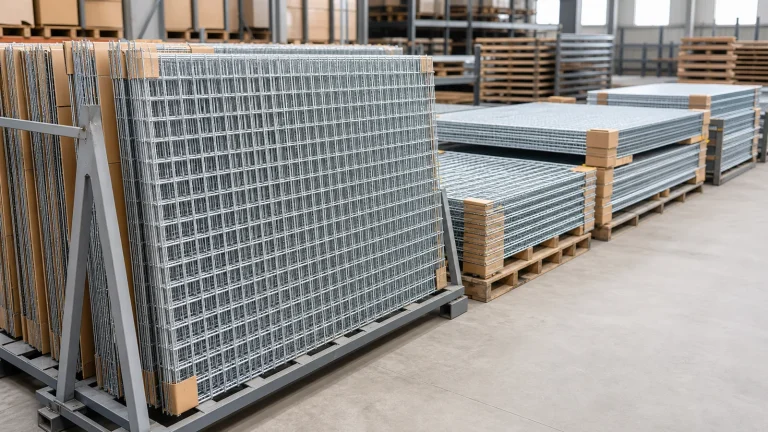
For hardware importers, construction-material distributors, agricultural-supply buyers, and fencing channels, the purchase order should define the finished panel rather than only requesting “welded mesh.” The same general name can cover different wire gauges, grid openings, panel sizes, coatings, borders, and packing methods. A clear specification protects both the supplier quotation and the receiving warehouse.
Start with the panel application, not a generic mesh name
The target application determines which panel characteristics need the tightest control. A fencing program, animal enclosure, storage guard, construction-related application, or agricultural channel may each use a different panel dimension, opening, wire diameter, finish, and border style. Buyers should state the intended market and use, then confirm the exact approved panel model with a drawing, retained sample, or both.
A useful inquiry records overall length and width, nominal mesh opening, wire diameter in each direction where relevant, panel shape, border treatment, finish, quantity per bundle, pallet plan, and inspection points. It should also distinguish panels from rolls. A flat panel is handled, stacked, protected, and received differently from a coil or roll, so the supplier needs the correct product definition before quoting.
Do not rely only on a product photograph. Perspective can hide a bowed panel, uneven outer wires, inconsistent opening geometry, or rough cut edges. The buyer should keep an approved visual reference together with measurable values.
Wire diameter and aperture need practical tolerances
Wire diameter and mesh aperture are the two measurements most buyers notice first, but both need an agreed checking method. The order sheet should state the nominal wire diameter, whether it refers to the core wire or finished coated surface where that distinction matters, the nominal opening, and a practical tolerance. Measurements should be taken from more than one location on a panel and from more than one panel in the batch.
Opening size should be checked in both directions, especially where a square or rectangular grid is specified. A panel can look regular at a distance while the opening changes near the edge or drifts across its width. That variation can affect fitting, cut planning, and the customer's visual expectation. The goal is not an unrealistic zero-tolerance grid; it is a panel that matches the approved specification consistently.
Importers should also decide how to treat wire-diameter variation caused by the selected surface treatment. A coating can change the finished dimension and appearance, while the underlying wire controls the panel's basic structure. Keeping this distinction clear avoids arguments based on two parties measuring different points of the same wire.
Weld integrity is a product requirement, not a cosmetic detail
Each welded intersection is part of the panel structure. Inspection should look for missed welds, weak-looking joins, excessive burn-through, sharp projections, obvious weld build-up, and locations where the crossing wires do not sit in a consistent plane. A small sample can be used for agreed weld checks, while the broader visual inspection should cover the whole panel face and its edges.
The supplier and buyer should agree what evidence is appropriate for the product grade: visual inspection, dimension checks, selected sample checks, and production records where needed. Do not assume a panel is suitable for a particular structural use solely because it is welded. The relevant application, local requirements, and buyer's engineering needs determine whether any additional testing or certification is necessary.
Good weld control supports repeat orders as well as first shipments. When a buyer retains an approved panel sample and uses the same inspection locations on later orders, it is easier to spot a process change before a full container is loaded.
Panel flatness and perimeter edges affect installation and handling
Flatness is one of the practical differences between a panel program and a roll program. A panel that is bowed, twisted, or unevenly stressed can be hard to stack and difficult for the customer to fit into a frame or fence line. A flatness check can use a stable reference surface, straightedge, and an agreed method for assessing visible lift or distortion. Check representative panels from different parts of the production lot and pallet stack.
Perimeter wires and cut ends require equal attention. The buyer should define whether the outside border is a trimmed wire edge, an overhang, a reinforced edge, or another approved form. Jagged points, inconsistent overhang, loose ends, and damaged corners create safety, packing, and presentation problems. Edge expectations should be visible on the approved sample and recorded in the order sheet.
Panel dimensions, diagonal comparison, and corner shape also help reveal whether the grid has been pulled out of square. A small dimensional error may be tolerable for one channel but unacceptable for a fabrication customer. The destination use should determine the tolerance and sampling plan.
Finish should be checked across faces, welds, and edges
Galvanized or coated steel panels are purchased for both appearance and resistance to normal transport and storage conditions. The order should state the selected surface treatment and practical acceptance standard. Inspect both sides of a panel, the welded crossings, and the cut edges for uneven coverage, bare-looking areas, early rust, flaking, or damage caused by handling.
Finish selection should match the market and product position. A buyer does not always need the same surface standard for every wire panel, but the received batch must be consistent with the approved sample. Packing and storage remain important because abrasion between panels, wet transit conditions, or damaged wrap can affect the surface even when the factory finish was acceptable.
Use a pre-shipment inspection plan that matches panels
A panel inspection should confirm the SKU, overall dimensions, wire diameter, opening size, weld condition, flatness, perimeter edge treatment, surface finish, bundle quantity, corner protection, pallet stability, and carton or bundle marks. Sampling should cover panels from different production periods and pallet positions. A single clean panel placed on an inspection bench cannot represent the whole shipment.
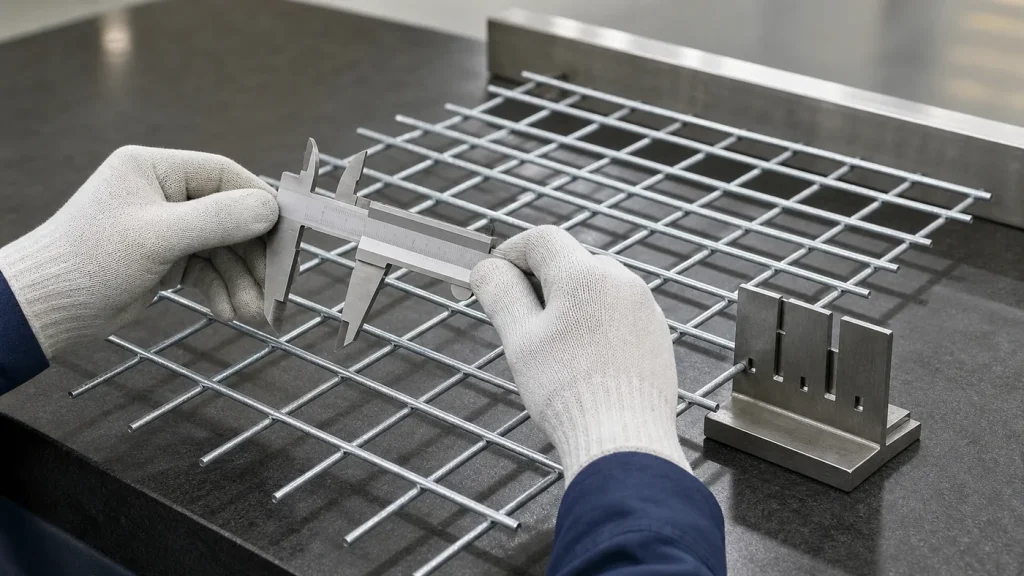
Photos should show the measured opening, wire, panel edge, weld intersections, and packed stack. These records help the receiving team compare the shipment with the approved reference. They also create a clear basis for discussing a variation before the cargo leaves the factory.
Flat stacking and pallet protection are part of the specification
Panels are vulnerable to corner damage, edge abrasion, bending, and stack movement. A dependable packing plan begins with flat, aligned stacking and separators that reduce metal-to-metal rubbing. It should then define corner guards, edge protection, timber battens or other rigid support where appropriate, restraint method, stretch wrap, pallet dimensions, gross weight, and safe forklift access.
The stack must remain stable through loading, sea freight, unloading, and warehouse handling. Over-tight restraint can deform a panel stack; insufficient restraint allows movement and corner damage. Pallets should be selected for the actual panel footprint and weight rather than for factory convenience. The buyer should ask for packing photos before shipment, including the pallet base, corners, top protection, and straps.
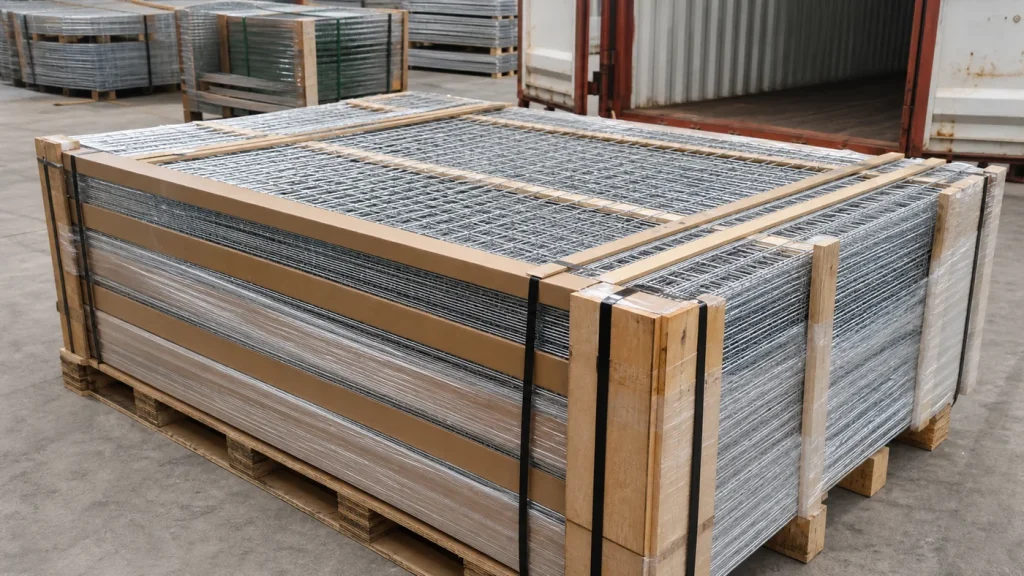
Container planning should protect the panel faces from shifting cargo and should account for the dense weight of stacked steel panels. Confirm the loading orientation, any dunnage, pallet sequence, and destination unloading equipment before the doors are sealed. The buyer should not assume that unused container volume means the load is safe or easy to receive.
Build a panel range around what customers can store and use
A small set of well-defined panel sizes and openings is often easier for distributors to inspect, store, and sell than a large collection of near-duplicate grids. The range should reflect local demand, framing systems, storage capacity, and the way customers transport panels. A warehouse that cannot safely handle a very large panel may benefit more from a controlled, stackable format than from the largest possible sheet.
Each SKU should keep its own specification record: dimensions, aperture, wire diameter, finish, edge form, panels per bundle, bundle weight, pallet format, and visual acceptance points. This gives a purchaser a reliable way to compare offers and helps a receiving team identify the correct stack without opening every bundle.
Use an order sheet that connects production to receiving
A complete welded-panel order sheet should include the approved drawing or sample reference, intended channel, panel length and width, diagonal and flatness method where needed, aperture and tolerance, wire diameter and measurement basis, weld acceptance points, perimeter edge form, surface finish, bundle quantity, separators, pallet dimensions, protection method, gross-weight limit, marks, and inspection records required before loading.
Welded wire mesh panels become a dependable product line when the buyer controls the panel as a finished grid: accurate openings, consistent wire, sound welds, flat shape, clean edges, suitable finish, and protected stacking. Those details turn a visually simple panel into a repeatable wholesale item that can arrive, store, and install with fewer surprises.