
Barbed wire is easy to reduce to a roll diameter and a price per coil, but the roll is only the final form of a fencing product with several controls behind it. For farm-supply importers, fencing distributors, and hardware wholesalers, the practical questions are the line-wire construction, wire diameter, barb form, barb spacing, metallic coating, roll length or net weight, tension, and how safely the coils can move through loading and receiving. A product that looks similar from a distance can differ materially in coverage, handling, corrosion resistance, and the way a contractor or dealer experiences the roll.
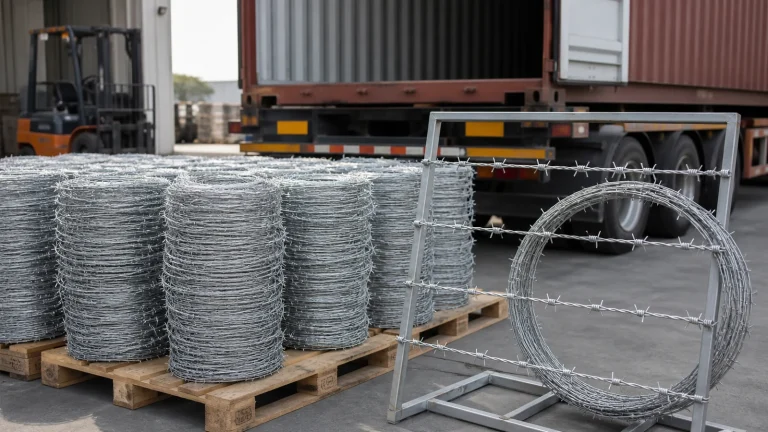
A purchasing description should therefore define the actual fence wire a customer will receive, not simply say “galvanized barbed wire.” A suitable specification begins with the intended market and fencing use, then makes each repeatable feature measurable. It also distinguishes the barbed wire from the other wire products in the range: hexagonal wire netting is a mesh roll with its own aperture and selvage controls, while binding wire is selected around a different forming and handling task.
Describe the construction before asking for a quotation
Conventional barbed wire normally uses two line wires twisted together, with barbs tightly wound around the strands at intervals. The line wires carry the fence run; the barb arrangement supplies the deterrent feature. A quotation should state the construction in a way that identifies both, including the number of points per barb where relevant, whether the required pattern is conventional or reverse twist, and the direction or form of twist if that affects a retained approval sample.
Do not let a broad trade name replace the construction. Two coils may have a similar outside diameter while using different line-wire diameters, barb-wire diameters, pitch, barb length, coating systems, or actual net content. Those differences affect material consumption and the way a distributor presents the SKU. The approved sample and purchase order should use the same vocabulary so that factory, inspector, freight team, and destination warehouse are comparing the same product.
If a tender, customer specification, or destination regulation calls for a named standard, state the exact designation and edition in the order. ASTM A121 and ISO 7900 are examples of standards that address metallic-coated steel barbed wire, but the buyer should not assume that a reference to one standard automatically makes every construction, coating, or local installation requirement suitable. Confirm the applicable market requirement before release.
Control line wire, barb wire, and spacing as a single SKU
The line-wire size and barb-wire size should be written separately, using the buyer's chosen unit and tolerance. The order should also identify the finished construction, rather than relying on a supplier's internal gauge name. Measure the actual wire on an approved sample and keep the measurement points clear: line wires, barb wire, and the finished twisted section do not represent the same dimension.
Barb spacing, often called pitch, should be measured along the roll under a consistent inspection method. A single opening near the coil end is not enough evidence. Inspect several segments from different coil positions and record the number of spaces measured, the measured length, and the resulting pitch. Check that barbs are firmly formed, centered around the line wires, and not visibly loose, flattened, incomplete, or clustered. The aim is not cosmetic perfection; it is a repeatable pattern that matches the ordered construction.
Barb length and point form should also be agreed by sample. Sharp material must be handled with appropriate controls during inspection and receiving. The buyer's acceptance standard should focus on consistent construction, safe coil restraint, and absence of obvious defects rather than encouraging unnecessary manual handling of exposed wire.
Specify coating by type and required evidence
For outdoor fencing, coating is a product requirement, not a label. Specify the required metallic coating system, the relevant coating class or mass where the market specification requires it, and the test or certificate expected from the supplier. Zinc-coated and zinc-alloy-coated products are not interchangeable wording. The correct choice depends on the intended environment, customer requirement, price position, and standard named in the order.
Coating quality should be checked alongside the wire construction. Look for bare-looking areas, loose flakes, heavy lumps that interfere with twisting, early corrosion, and inconsistent appearance across several coils. A supplier certificate can support the record, but it does not replace sampling of the physical shipment. Where coating mass or adhesion is contractually important, define the test method, sampling plan, acceptance criterion, and lot traceability before production rather than trying to reconstruct them after loading.
Do not promise a universal service life from a general coating description. Weather, salts, pollution, installation method, abrasion, and local fence maintenance all influence field performance. The procurement objective is a verified coating and construction that meet the selected specification and arrive in protected condition.
Check roll content, tension, and coil restraint before shipment
Roll length and net weight are commercial controls as well as warehouse controls. Some markets buy by stated running length, while others buy by a defined coil weight. The order should make the commercial unit explicit and state the permitted tolerance, how it is checked, and whether the label must show length, weight, or both. A coil can look full while still being short if the product definition was not fixed.
Roll tension affects how the customer can install and store the wire. An excessively loose coil can shift, snag, and become difficult to control; an over-tight coil can create poor handling behavior when restraints are removed. Request a retained packing sample that shows the required coil diameter, width, tie or band locations, end restraint, and label position. The coil must remain compact through normal freight and unloading without hiding its SKU identity.
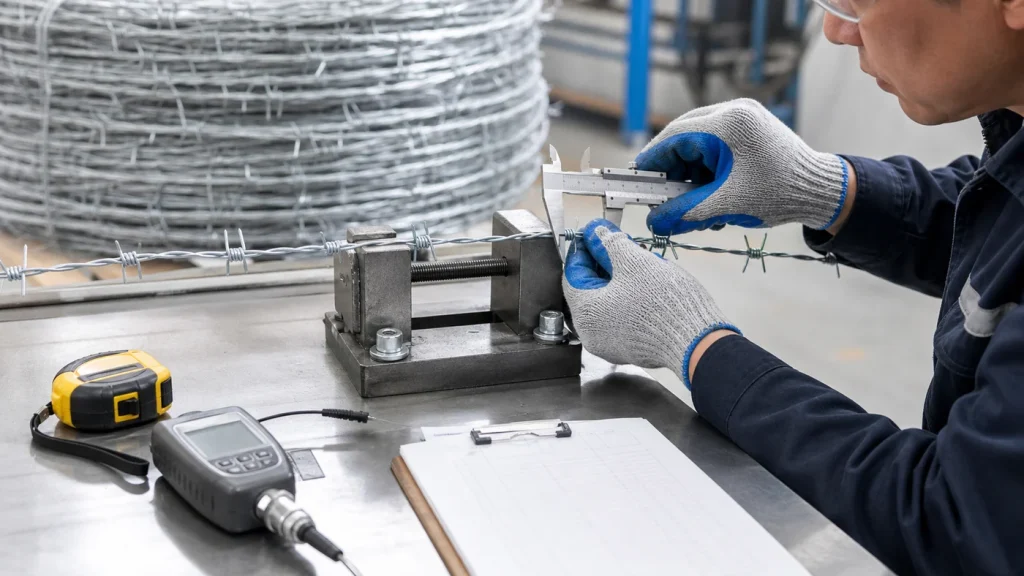
Inspection records should show the product, coil label, measurements, and sampled lot. Pull samples from more than one coil and pallet location. This is especially important for repeat orders, because a good pre-production coil does not prove that every later coil has the same construction, coating, or roll content.
Pack barbed wire for safe export and practical receiving
Barbed wire is a high-contact product: one loose coil can damage adjacent packs, scratch workers, or complicate unloading. Each coil needs deliberate restraint, a protected end, and a label that remains visible after bundling. The master packing plan should specify coil count per bundle or pallet, stacking orientation, wrap or cover, edge protection, straps, pallet dimensions, gross weight, and the maximum stack height appropriate to the destination equipment.
Coils should be grouped by SKU and production lot, not mixed casually because their outside diameters happen to match. When several sizes share a container, the packing list should give each SKU's coil count, net weight, gross weight, pallet count, and location. This makes a destination warehouse capable of receiving the shipment without cutting open bundles just to identify the product.
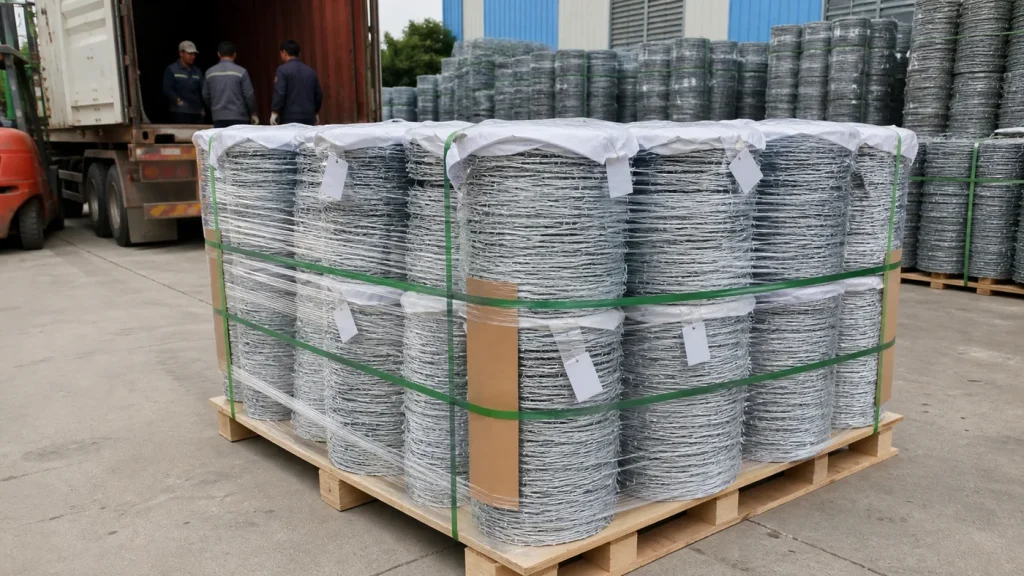
Container loading needs a realistic weight and movement plan. Keep coils from rolling, avoid placing dense pallets where they can crush lighter hardware, and account for the condition of the container floor, available forklift access, and destination unloading sequence. Moisture protection should be planned for the actual route and storage conditions rather than added as an afterthought at the door.
Build a focused range instead of a list of nearly identical coils
A distributor benefits from a range that matches local fencing practice and stock-turn reality. Start with a limited set of constructions, coatings, and roll formats that customers can distinguish and warehouses can receive. Add variants only when they solve a defined market need. Too many near-duplicate roll weights or pitches make sampling, carton or bundle labeling, replenishment, and customer communication harder without necessarily improving the line.
For each SKU, maintain a simple control record: approved sample reference, line-wire and barb-wire description, construction and twist, barb spacing, coating requirement, roll length or net weight, coil dimensions, restraint method, bundle or pallet count, gross-weight limit, labels, and inspection method. That record turns a commodity request into a repeatable fencing program.
Use an order sheet that prevents avoidable variation
A complete barbed-wire order sheet should identify the intended market and use, standard or customer specification where applicable, line-wire and barb-wire dimensions, construction, twist pattern, points per barb, barb spacing, coating type and required evidence, roll unit and tolerance, coil dimensions, restraint and end protection, bundle or pallet plan, marks, packing-list fields, and inspection requirements. It should also state which features are critical for the distributor's sales channel and receiving workflow.
Reliable barbed wire sourcing depends on details that are easy to miss in a price comparison. Defined construction, measurable pitch, appropriate coating, verified roll content, controlled coil restraint, and safe receiving-oriented packing give importers a fencing SKU that is easier to inspect, sell, and reorder.