
A supplier sends a convincing hoe head, a well-finished shovel, or a neat mesh sample. The buying team replies, “Approved, please proceed.” Weeks later, the shipment arrives with a different handle fit, a changed finish, or a material claim that nobody can connect to the original sample. The problem is not always that the factory ignored instructions. Sometimes the instructions never defined what approval actually covered.
For hardware importers and distributors, sample approval should produce a controlled reference for manufacturing and inspection, not just a positive email. This guide explains how to connect a physical sample to a specification, how to manage revisions, and when to require new evidence. The workflow below is a practical purchasing framework, not a universal product standard or a substitute for market-specific compliance review.
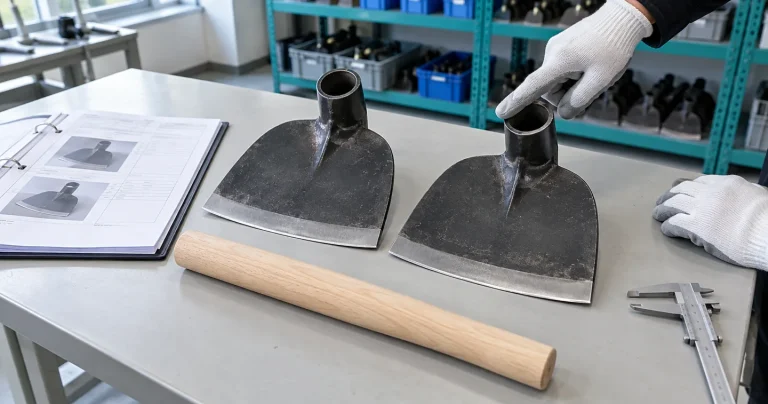
1. Separate selection samples from production approval
A catalog sample answers a commercial question: is this the product family we want? It may come from existing stock, use another customer’s finish, or have been made with a process different from the planned order. It is useful for range selection, but should not silently become the reference for your private-label production.
Use distinct statuses in the sample log. A development sample is for resolving design and fit. A pre-production sample is presented for approval against the proposed production specification. A retained reference, often called a golden sample, records the approved configuration. A sample drawn from production is evidence about that production run, not permission to change the reference.
Ask the supplier which materials, tooling, components and manufacturing steps will differ between the submitted sample and bulk production. Record every difference and decide whether another sample is needed. QIMA’s sample review and picking service likewise distinguishes development, pre-production confirmation and shipment sampling; these are different checkpoints rather than interchangeable sample names.
2. Give each sample an identity that survives an email chain
Assign an approval reference that links the buyer’s SKU, supplier model, revision and individual sample number. Record the date received, factory identity, stated sample origin, reviewer and current status. A simple example is HOE-A / Rev 02 / Sample 03. The format matters less than consistent use across the sample label, purchase order, drawing and inspection instructions.
Photograph the whole product and the important details, including interfaces and markings. Include the sample ID in the record, and use a scale where dimensions matter. Photos help identify the reference but do not reliably prove material grade, hardness, coating thickness or strength. Keep original reports and measurements alongside them rather than treating a photograph folder as a technical file.
For an assortment, maintain a row for each SKU. Do not approve a whole garden-tool range because one rake was satisfactory. If several items share a component, identify exactly which evidence is transferable and which dimensions, interfaces or uses still require separate review.
3. Turn “same as sample” into measurable requirements
A physical reference is useful for shape, feel and workmanship. It is much weaker as the only definition of an allowable dimension or an invisible property. Attach a specification that states the feature, requirement, tolerance, measurement location, method and evidence expected. Do not let the factory infer a tolerance from the last digit of a catalog description.
- Tool heads: distinguish finished head weight from complete-tool weight; identify the socket or eye dimensions and the intended handle interface.
- Handled tools: specify the approved head-and-handle combination, assembly method and relevant verification, not just overall length and color.
- Wire products: distinguish wire diameter from finished mesh dimensions, and record the coating requirement separately from visual appearance.
- Nails: identify length, shank, head, point, finish and commercial pack quantity using the same units throughout the order.
- Cutting blades: control the exact model, dimensions, intended application and required safety information; a visually similar disc is not automatically an equivalent.
These are fields to define, not universal acceptance limits. The right values depend on the product, intended use and applicable requirements. Our wooden tool handle guide covers the interface and material questions that need to sit behind a handled-tool approval.
For example, a hypothetical non-safety dimension of 100.0 mm with an agreed tolerance of plus or minus 1.0 mm means an acceptance range of 99.0 to 101.0 mm under the agreed measurement method. A sample measuring 100.4 mm does not make 100.4 mm the new target. This example illustrates documentation only; it is not a recommended tolerance for any hardware product.
4. Separate appearance approval from performance evidence
A smooth finish does not demonstrate steel grade, and a successful hand assembly does not establish joint strength. Divide approval into visible characteristics, measured characteristics and properties requiring a defined test. Record which of these have actually been checked, by whom, and on which sample.
Where testing is required, agree the method, specimen preparation, number of samples, acceptance criteria and reporting needs before commissioning it. Destructive tests consume or alter samples, so keep an untouched reference separately. Do not ask a warehouse worker to improvise an impact, pull-out or high-speed blade test; relevant tests need competent personnel, suitable equipment and appropriate safety controls.
Check that any report identifies the model or sample tested and the relevant revision. A report for another material, another handle joint or a previous construction may not support the current order. Approval of a reference sample also does not establish that every subsequent unit complies with a destination’s requirements. Product-specific verification remains a separate task.
5. Make the approval decision unambiguous
Use clear outcomes: approved for the stated configuration; rejected with reasons; or not approved pending specified actions. Avoid “approved, but change the socket and coating” because it leaves the factory guessing whether production may begin before those changes are checked.
If a limited activity is authorized before full approval, describe that activity and its limits explicitly. An authorization to prepare artwork is not an authorization to manufacture the complete order. Name the person who may release production and require the supplier to acknowledge the same revision in writing.
Agree how conflicts will be resolved when the physical sample, specification, drawing or purchase order disagree. A useful operating rule is to stop the affected work and request written clarification, not to let the factory choose whichever document is easiest to meet. Record the corrected requirement in the controlled file before restarting.
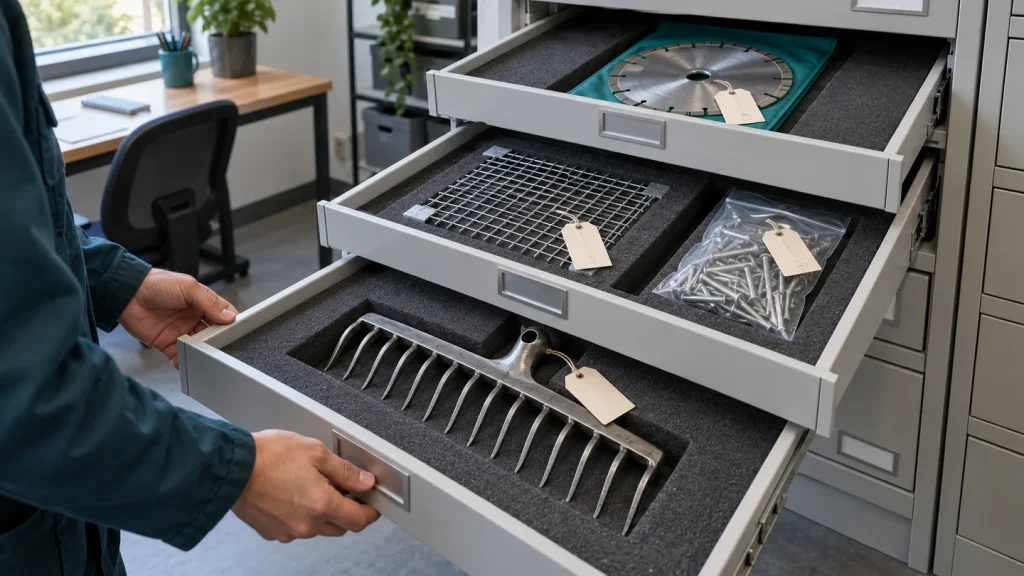
6. Keep a usable reference, not an aging object in a drawer
Where practical, retain identified counterparts with the buyer and factory, and make a reference available to the inspector. Compare those counterparts before sign-off; “same model” is not enough if they came from different revisions. Use tamper-evident identification where appropriate and log who holds each unit.
Protect sharp edges, separate products that could damage one another, and store references in conditions suitable for their materials. Corrosion, wood movement, worn edges and repeated handling can make an old reference misleading. Record its condition, control access and review it when deterioration could affect comparison. The approval date and revision remain important even when the sample still looks new.
Packaging artwork and labels need their own version control. Link their approved files to the product approval without letting a label change conceal a product change. For carton and receiving details, use the separate private-label hardware packaging checklist.
7. Verify the first production run against the approved package
A golden sample is a benchmark, not proof of batch consistency. Before production, confirm that the factory has the current specification and reference. Early in the run, compare actual output with the agreed package while correction is still practical. Later inspection should examine units selected from the defined production lot, not only the supplier’s best display pieces.
Define inspection scope, lot identity, sampling approach, tests and release responsibilities in advance. A sample-based inspection reduces uncertainty but does not guarantee that every unit is defect-free. Neither a good sample nor an acceptable visual inspection replaces testing that the product or customer requires.
SGS notes that approved references help compare production with the order, and describes checks at different manufacturing stages. Its final random inspection service is a separate batch-quality checkpoint. The practical lesson is to connect sample approval and shipment inspection, rather than choosing one instead of the other.
8. Require approval before substitutions and repeat-order changes
Write a change-notification requirement into purchasing instructions. It should cover relevant changes to material, component source, tooling, heat treatment, coating, dimensions, assembly and production location. The supplier should explain the proposed change, affected SKUs, reason, supporting evidence and first affected lot before implementation.
The buyer then decides what needs rechecking. A packaging artwork correction and a different handle joint do not have the same risk. A component or process change may require new samples or tests; a purely administrative correction may only need document review. Record the decision rather than using a blanket rule that every change is harmless or that every change requires the same testing.
Do not overwrite the old approval. Issue a new revision, identify when it takes effect, and separate remaining old-revision stock from new output. For repeat orders, ask the supplier to confirm either “no changes from the approved revision” or list the changes. A familiar SKU number alone is not evidence of an unchanged product.
A compact approval record for the next purchase order
Before authorizing production, make sure one controlled record answers these questions:
- Which SKU, factory, model, revision and sample are being approved?
- Was the sample made using the intended production materials and process?
- Which drawing, specification, artwork and test reports apply?
- What was measured or tested, and what remains unverified?
- Are all requested corrections closed, with evidence attached?
- Who approved production, on what date, and with what scope?
- Where are the retained references, and what is their condition?
- How will production be checked and future changes authorized?
The objective is not a larger pile of samples. It is a shared, traceable definition of the product being purchased. When the factory, buyer and inspector work from the same approved revision, disagreements become specific questions about evidence and requirements instead of arguments about whether the shipment “looks close enough.”
Images are original AI-generated editorial illustrations of sample-control workflows, not photographs of an audited factory, inspected shipment or certified product.