
A container can leave the factory with dry-looking cartons and arrive with stained nail packs, rusty tool faces or damp labels. For a hardware importer, the loss is not limited to cleaning the metal. Sorting, repacking, customer complaints and delayed warehouse release can turn a low-cost shipment into an expensive receiving problem.
Preventing rust in hardware shipments requires a plan for the product, its immediate packaging and the container environment. Adding a few drying bags at the loading door is not a complete specification. This guide focuses on moisture and corrosion control for nails, wire products, steel items and agricultural hand tools, rather than carton artwork or SKU labeling.

Why a weather-tight container can still contain water
Rain entering through a damaged roof or door seal is one failure mode. Condensation is another: humid air can release water onto a surface that is below its dew point. Temperature changes during transport can therefore produce wet surfaces even without a visible leak.
Moisture may already be present in the cargo, wooden packing materials, cartons or enclosed air when the doors close. Hapag-Lloyd’s container packing guide describes how condensation can collect on container surfaces and drip onto cargo. A sound container helps keep external water out; it does not remove moisture brought inside.
Ask the factory to map the exposure period from final production through packing, inland transport, port waiting, sea transit and destination storage. The ocean voyage is only part of the timeline. Record the expected route and season, likely delays and any unpacking or repacking steps. Those details give a packaging specialist something more useful than the instruction “suitable for export.”
Start with a product-specific risk list
Do not assign one rust-prevention method to every item in a mixed hardware order. Create a short risk record for each product family, with the exposed material, finish, moisture-sensitive components, planned storage period and receiving requirements.
- Bright steel nails and uncoated wire: identify the required surface condition at delivery and whether an approved temporary protective treatment is acceptable.
- Painted tool heads: identify exposed working faces, edges, sockets and contact points. A painted exterior does not define protection for every surface.
- Galvanized mesh and sheet: include trapped moisture between contacting surfaces in the review, rather than assuming galvanizing eliminates all storage concerns.
- Tools with wooden handles: assess the complete pack, including the handle condition, not just the metal head.
- Retail-ready hardware: ask whether residues, odor, stained inserts or removal of a protective film would create extra work for the seller.
For handled products, coordinate this review with the wooden handle sourcing requirements. A metal-protection decision should not be made separately from the condition of the rest of the assembled tool.
Distinguish three different protection functions
1. Surface protection
A specified temporary rust preventive acts at the metal surface. If oil or another removable treatment is proposed, ask for its technical data, application instructions, material compatibility and removal requirements. Approve the actual finished pack, including contact with handles, printing, adhesives and retail inserts. Do not allow the factory to substitute an unidentified lubricant simply because it looks similar.
2. VCI packaging
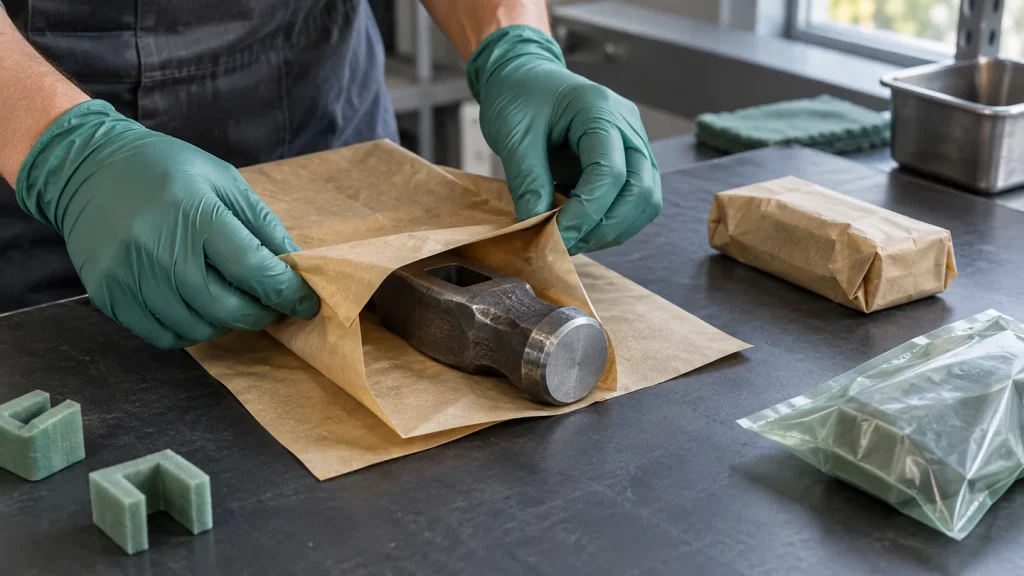
Vapor corrosion inhibitor, or VCI, materials release corrosion-inhibiting substances within an enclosure. They are not merely colored plastic bags or brown wrapping paper. Cortec’s VCI paper instructions describe wrapping or interleaving metal and closing folds to limit free airflow. Follow the instructions for the exact material selected, not a generic method borrowed from another product.
Request the manufacturer’s product code, supported metals, storage life, coverage guidance and closure requirements. Check that edges cannot puncture the protective enclosure during handling. Approve how inspectors will open and restore the pack. A bag left open after inspection is no longer the same packaging configuration that was evaluated.
3. Moisture control
Desiccants take up moisture and have finite capacity; their function differs from that of a corrosion inhibitor. ZERUST’s technical FAQ explains this distinction and recommends validating applications with different materials. VCI and desiccants may be used together in an appropriately designed system, but that does not make every combination or placement suitable.
Ask the packaging provider to specify the selected desiccant, quantity, enclosure, position and expected protection period for the actual application. A packet inside a product bag and a drying unit mounted inside the container operate at different levels. Neither should be credited with unlimited capacity. Keep packages intact, follow handling instructions and prevent contact or leakage where the supplier prohibits it.
Do not replace a design calculation or validated trial with a rule based only on container length. Cargo moisture, packaging permeability, transit duration and environmental exposure all belong in the supplier’s assessment. Reject proposals that give a protection claim without stating the conditions under which it applies.
Make dryness a packing prerequisite
Build a release checkpoint between production and packing. The record should identify who checked the goods, the relevant drying or conditioning procedure, packing-material condition and any exceptions. Do not treat a brief exterior glance at a bundle as evidence about all of its contents.
Where timber moisture is controlled, specify the measuring method, locations and acceptance requirement appropriate to the packaging design. Keep readings tied to the material lot. Avoid copying a single moisture percentage into every purchase order without considering the material and method. A treatment or supplier stamp is not a substitute for the agreed condition check.
Handle unexpected rain exposure as an exception requiring assessment. Do not close wet goods or damp packing materials inside a protective bag and assume the bag solves the problem. Record what became wet, how it was evaluated and who authorized reuse or replacement. Preparation matters before any final protective layer is applied.
Inspect the container before loading starts
Give the loading team a brief, signed condition checklist. Check the accessible roof, walls, floor, doors and seals for damage, visible moisture, stains or residues that require investigation. Record the container number and dated photos before cargo hides the surfaces. Keep the team clear of moving equipment and follow the site’s container-entry procedure.
Hold loading if the container or packing conditions are unacceptable. Record corrective action or replacement rather than simply photographing the defect and proceeding. Load under suitable weather protection, keep accepted materials out of rain, and assign someone to verify the specified moisture-control equipment before the doors are closed.
Do not improvise ventilation changes or block designed openings based on an assumption that more or less airflow always solves condensation. Agree the container and package approach with the carrier or competent packing specialist. Secure any protective equipment so it does not become a loose object or interfere with cargo restraint.
Galvanized goods need a different damage assessment
White or grey deposits on galvanized steel can be wet storage stain, involving corrosion products of the zinc coating rather than ordinary red rust of bare steel. The American Galvanizers Association explains that moisture trapped between closely stacked galvanized articles can create this condition.
Do not automatically dismiss all white deposits as harmless, or reject the entire lot based on color alone. Record severity and extent, then obtain a coating-specific assessment. Keep handling and any remedial work consistent with the coating supplier’s guidance. This is particularly relevant to galvanized sheet and steel products with closely contacting surfaces.
Use a trial shipment to test the process
For a new route, finish or packaging system, agree a trial with traceable lots. Document the packing revision, materials used, closure method, loading conditions and destination inspection. A temperature and humidity logger may help explain exposure, but a reading at one position does not describe every carton or prove the condition of every metal surface.
Choose logger locations deliberately, record where they are placed, and agree who retrieves the data. Evaluate the physical goods alongside the record. Compare equivalent products and document differences between trials; otherwise a successful shipment may be credited to the wrong packaging change.
Turn the accepted arrangement into a controlled specification using the sample approval and change-control workflow. Require review before changing the protective material, bag construction, closure method or supplier. A familiar product SKU does not mean its transit protection is unchanged.
Receiving checks should preserve evidence and limit further damage
At arrival, record the container and seal details, visible interior condition, pack locations and any damp or damaged areas. Identify affected SKUs and lots before goods are mixed into ordinary stock. Photograph unopened packs, then selected contents, keeping the connection between outer condition and product condition clear.
If corrosion or moisture is found, segregate affected goods and obtain appropriate drying, handling and technical assessment instructions. Avoid immediately polishing, oiling or discarding the evidence. At the same time, do not leave wet goods deteriorating simply to preserve a photograph. Record any necessary mitigation and retain representative packaging and samples.
Notify the responsible supplier and logistics contacts promptly under the relevant arrangements. The evidence should help distinguish water entry, condensation, pre-existing corrosion, damaged packaging or a process deviation. A photograph of rust alone does not establish when or why it formed.
The purchase-order checklist
- Identify vulnerable materials, finishes and the required delivery condition.
- State the route, expected protection period and destination storage assumptions.
- Approve surface treatment, VCI or barrier materials and moisture-control design separately.
- Define packing prerequisites, closure instructions and inspection resealing.
- Record container acceptance, loading conditions and equipment placement.
- Assign responsibility for trial results, receiving evidence and packaging changes.
Reliable corrosion prevention is a documented process, not an accessory added at the last minute. The buyer’s job is to make the protection requirements explicit, have the proposed system assessed for the actual goods and route, and verify that the approved process survives production, inspection, transport and receiving.
Images are original AI-generated editorial illustrations, not photographs of a verified shipment or proof of a packaging system’s performance. Product-specific protection and test requirements should be agreed with qualified suppliers or specialists.