
Common nails look interchangeable until a distributor receives cartons that are the right nominal length but the wrong shank diameter, finish or pack weight. A buyer who orders only “common nails, 3 inches, galvanized” has left several commercial and functional decisions to the factory. The consequences can be a rejected retail SKU, a poor fit for the intended application, or a warehouse full of cartons that cannot be counted consistently.
This guide turns common nails into a controlled purchasing specification. It is for importers, wholesalers and hardware retailers building repeatable assortments, not a substitute for an engineer’s connection design or the building rules of a destination market.
First decide which nail the customer actually needs
“Common nail” is a product style, not a synonym for every general-purpose nail. Box, sinker, roofing, concrete, finishing and collated nails may share a nominal length yet differ in body diameter, head, point, surface or intended use. In wood construction, those differences can affect prescribed fastening schedules and engineering values. The American Wood Council’s NDS material distinguishes common, box and sinker nails in its tables; do not substitute one style for another based on length alone.
Start with the sales channel and intended use: bulk stock for a hardware merchant, a small retail pack, a specified construction application or a private-label assortment. Obtain any destination-market code or customer requirement before choosing a nail. A generic export catalogue photo is not evidence that a nail will meet a particular building schedule.
Write a measurable SKU, not just a trade name
For each SKU, record the nail style, material, nominal length, shank diameter, head diameter and profile, point shape, shank form, finish, dimensional tolerances, mass or count basis, and packing format. Put units beside each dimension. If buyers use penny-size (“d”) names, include the exact length and diameter rather than assuming all markets or suppliers use the same conversion. A sample should be traceable to that written revision.
ASTM F1667/F1667M-21a is a reference specification for driven fasteners, including nail classifications and dimensional and finish requirements. The order should name the exact edition and applicable product style when claiming conformance. An ASTM reference does not automatically establish which nail a local building code permits, and not every regional product is supplied to ASTM dimensions.
For an initial assortment, keep a controlled SKU matrix: product code, common/box/other style, length, diameter, finish, pack size, carton weight range and destination. This prevents a reorder from silently switching to a thinner or different nail while retaining the same marketing name.
Head, shank and point are separate acceptance features
Inspect the underside and shape of the head, not only its visible top. A head that is too small, off-centre, cracked or poorly formed can be a practical failure even if nail length is correct. Confirm the specified round smooth shank or other design; a deformed shank is not an invisible upgrade, because its behavior and specification may differ. Check point formation for blunting, hooks and excessive asymmetry that can affect driving.
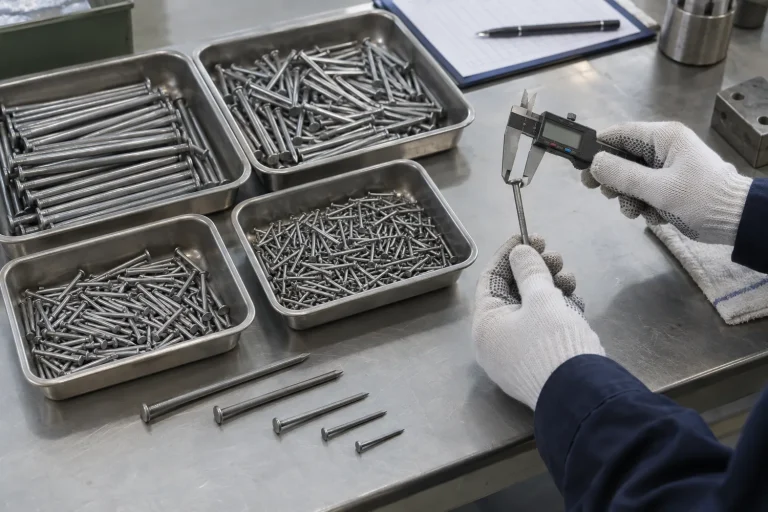
Use a suitable caliper and a documented sampling method to measure length, shank diameter and head diameter at defined positions. Record actual readings by SKU and lot, rather than a single photo of a caliper. ASTM F680-20 describes nail test methods that include dimensions, bend-related tests and coating tests; select only the methods needed by the governing product specification and purchase agreement. Driving performance or structural adequacy cannot be inferred from a desktop dimension check alone.
Specify the finish and exposure, not the word “galvanized”
Bright, coated and galvanized products serve different expectations. “Zinc coated” by itself does not define the coating process or thickness. If corrosion protection matters, specify the applicable coating standard and class, the intended exposure and any customer or code requirement. ASTM A153/A153M-23 covers hot-dip zinc coating on iron and steel hardware; it is not a blanket claim that every shiny nail has that coating. Confirm whether the chosen process and grade can be applied to this nail and market.
Agree how finish is verified: approved appearance sample, coating certificate where appropriate, and a test or inspection method when required. Rust on arrival may involve coating choice, wet packing, container condensation or storage; the response depends on the cause. Our shipment rust-prevention guide covers those transport controls separately.
Do not confuse kilograms with pieces
Bulk nails are often sold by net weight; retail buyers may plan by nominal piece count. The number of nails per kilogram changes with length, diameter, head and finish, so a universal “pieces per kg” table is unreliable. Decide which quantity is contractual. If a pack promises a count, verify count directly. If it promises net mass, agree the weighing method and exclude packaging weight. When both are shown, define which is guaranteed and which is indicative.
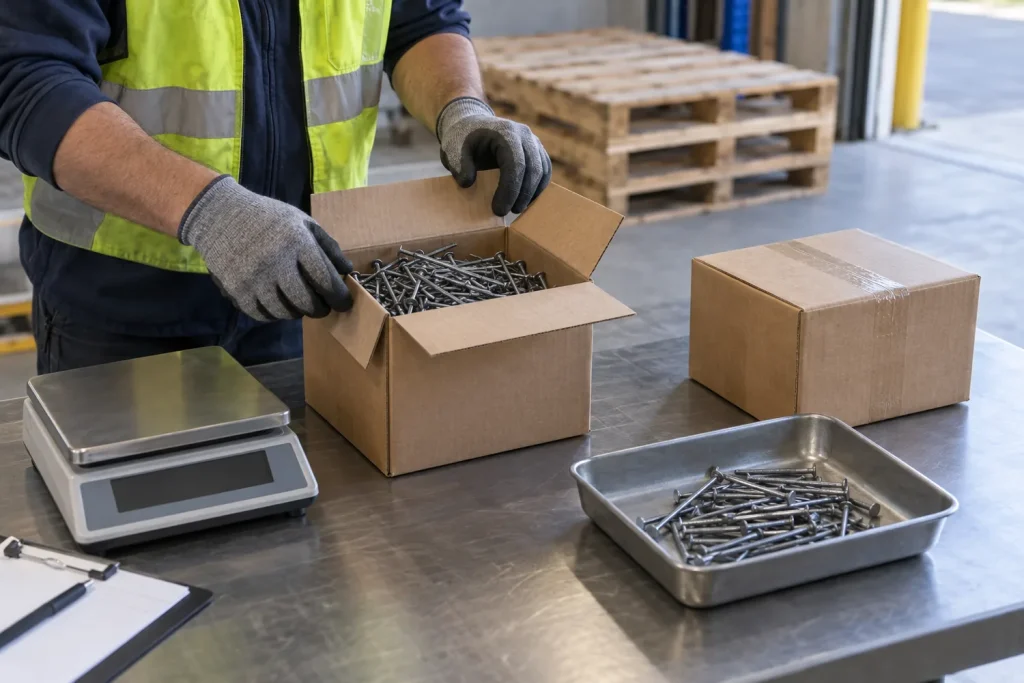
A practical receiving check uses a calibrated or verified scale, a defined sample of unopened packs or cartons, tare determination, and direct piece counting on selected packs. Record variability between packs as well as the average. Sampling a handful of nails, calculating an average unit mass and extrapolating to the entire shipment may help screen for major discrepancies, but it does not prove exact piece count when sizes or weights vary.
Make packaging survive handling and protect SKU identity
Nails are dense, sharp and unforgiving of weak cartons. Specify net and gross weights, inner containment, carton board and closure, handling limit, pallet pattern and moisture barrier where relevant. Test a representative packed carton through the agreed handling route; a neat empty-carton mock-up is not enough. Avoid carton sizes that are convenient for the factory but awkward or unsafe for the destination warehouse.
Each inner pack and outer carton should identify style, length, diameter, finish, net quantity basis, lot and SKU. If two nearby sizes use similar plain cartons, add a clear identification control; otherwise sorting errors can erase the freight saving of a mixed shipment. Do not mix sizes or finishes inside a single inner pack unless an intentional assortment has its own count and label specification. For a broader label and carton-mark program, see the private-label hardware packaging guide.
Control approval, inspection and receiving as one chain
Approve a production-intent sample against the written SKU before production. Preserve the sample, specification revision and packaging reference. If wire, tooling, finish process, carton supplier or production site changes, decide whether reapproval is required. A visually similar nail may not be identical in dimensions or coating.
At pre-shipment inspection, identify the lot by SKU and production batch, draw samples from more than one carton location, and check dimensions, head and point formation, visible finish, corrosion, mixed sizes, pack weights or counts and carton integrity against agreed criteria. Use a controlled defect list and record the sampled quantities and readings. The inspection planning guide explains lot definition and decision rules; an informal “pass” photo set is not a substitute.
On arrival, compare carton marks and pack lists before breaking down pallets. Quarantine unidentified or mixed cartons rather than relabeling from memory. Retain samples from disputed lots and note the lot codes on any claim. This gives the supplier a specific manufacturing or packing batch to investigate.
A concise purchase-order checklist
- Intended market and use, plus any applicable customer or code specification.
- Nail style, material, length, shank diameter, head diameter and shape, point and shank form, with units and tolerances.
- Surface finish or coating standard/class and evidence needed.
- Contract quantity basis: net mass, direct piece count or both, with a defined tolerance and method.
- Inner and master pack, carton gross weight, marks, lot identification and pallet requirements.
- Approved sample revision, change-control triggers, sampling and defect criteria.
Common nails are inexpensive per piece, but a full shipment is costly to rework or sort. The useful purchasing unit is therefore not just the nail; it is a precisely defined nail, in a verified pack, with a traceable lot that the buyer can receive and sell without ambiguity.
Images are original AI-generated editorial illustrations, not photographs of a verified factory, shipment or test result.