
A carton of metal cutting discs can look like a straightforward consumable purchase. But a wheel that fits a grinder is not necessarily rated for its speed, suitable for its material, or within its manufacturer-defined service life. For an importer, those differences affect safety, customer returns, stock rotation and the real cost of each cut.
This guide focuses on reinforced resin-bonded abrasive cut-off wheels for metal, commonly sold for portable angle grinders. These are different products from the diamond blades discussed in our diamond cutting blade guide. It gives buyers a practical way to specify, compare, receive and trace a wheel program. Operators must follow the wheel and machine makers’ instructions and the rules applicable to their work.
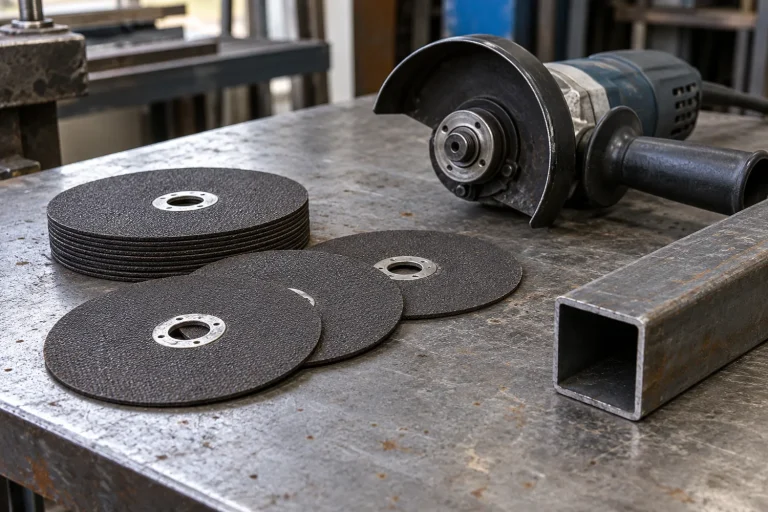
1. Start with the application and compatible machine
Ask what customers actually cut: mild-steel tube, stainless sheet, reinforcing bar or another material. Record whether they use a portable angle grinder, a stationary cut-off machine or a different tool. Wheels with similar diameters can have different approved applications, mountings and ratings. A disc designed for a portable grinder should not automatically be presented as suitable for a stationary machine, or vice versa.
Cutting, grinding and deburring are different operations. A thin cut-off wheel is designed for cutting at its edge; it is not a side-grinding wheel. Norton explains that the lateral strength of thin cut-off wheels is not intended for side grinding. If the customer also needs to remove a burr, include a separately specified product approved for that job rather than suggesting that the cutting wheel can do both.
For stainless steel, request a product specifically approved by its maker for that application and any necessary contamination-control requirements. Do not assume that a generic “metal” label promises suitability for every alloy or fabrication process.
2. Define the SKU beyond its outside diameter
List outside diameter, thickness and bore diameter in the same units and measurement convention. Also specify wheel profile and type, abrasive and bond, reinforcement, intended material, machine category, maximum operating speed, quantity per inner pack, and required product markings. The manufacturer should confirm which flange and mounting arrangement matches that design; never enlarge a bore or improvise a spacer to make a disc fit.
Thickness changes the product and the application. A thinner wheel can remove less material per cut, but it must still be selected and used within the maker’s design and instructions. A buyer should compare actual performance and breakage risk in the intended application, not simply presume that the thinnest or heaviest disc is always best.
Keep a SKU matrix that distinguishes, for example, a steel wheel from a stainless-approved wheel even when both share the same diameter and bore. Record the approved artwork and specification revision for each. A sample with a different label, thickness or reinforcement is not automatically the approved product.
3. Treat maximum speed as a compatibility requirement
The wheel’s marked maximum operating speed and the machine’s rated spindle speed must be compatible. Before mounting, check the manufacturer’s instructions and the actual tool rating; the grinder’s no-load speed must not exceed the wheel’s marked maximum RPM. For example, a wheel marked 12,200 RPM is not suitable for a grinder rated 13,000 RPM even if both accept the same nominal disc diameter. This comparison alone does not approve the wheel for that machine or application.
Peripheral speed in metres per second and rotational speed in RPM are related to wheel diameter, so do not compare an m/s figure with an RPM figure as if they were the same unit. Read both markings where provided, and ask the supplier to resolve a missing or contradictory rating before purchase. OSHA’s abrasive wheel machinery rule requires checking spindle speed against the wheel’s marked maximum before mounting in its applicable US workplace context.
4. Request evidence for safety and performance claims
Ask which product standard, edition and wheel type the supplier is claiming, and whether that claim is relevant to the destination market. If the packaging claims EN 12413 or another specification, request documentation identifying the exact factory, wheel family, dimensions and revision, together with the test methods and scope. A printed standard number, a generic certificate or a photo of a test machine is not independent proof that every SKU conforms.
Specify what evidence is needed for the order: product data sheet, traceable batch records, applicable test reports, marking artwork and instructions in the required language. Check dates, model numbers, laboratory identity and scope. Decide whether an independent test is needed based on risk, applicable rules and the buyer’s acceptance plan. Do not infer burst strength, reinforcement quality or conformity from visual appearance.
Samples for cutting trials should be evaluated by a competent test team using the correct equipment, guards and protective measures. Agree the workpiece material and dimensions, machine, method and stopping criteria in advance. Compare cut count, time, remaining diameter and visible results under the same conditions. A low-cost disc can be expensive in use if it wears quickly, but results from a small trial are indicative rather than a guarantee for every batch.
5. Build shelf-life and transit time into the order
Ask the manufacturer to explain the date marking, storage conditions and use-by period for the exact wheel. For some products the metal centre ring carries a validity date; a Flexovit catalogue illustrates one quarter-based marking system. That example is not a universal decoding rule: confirm the format and expiry policy for the product being purchased.
Set a minimum remaining shelf life at a named point, such as warehouse receipt, rather than vaguely requesting “fresh stock.” Work backwards from the manufacturer-defined use-by date: allow for ocean transit, customs clearance, distribution, retail sell-through and a reserve for delays. For example, if a buyer requires 18 months remaining at receipt, the order must state that requirement and how the dates will be checked. Do not extend a marked expiry date merely because the wheel looks undamaged.
Store stock in its original protective packaging under the maker’s recommended conditions, away from moisture, impacts and deformation. Norton’s storage guidance calls for monitoring the expiry dates on cutting and grinding discs. Use first-expiry-first-out rotation when dates differ and quarantine damaged or out-of-date stock.
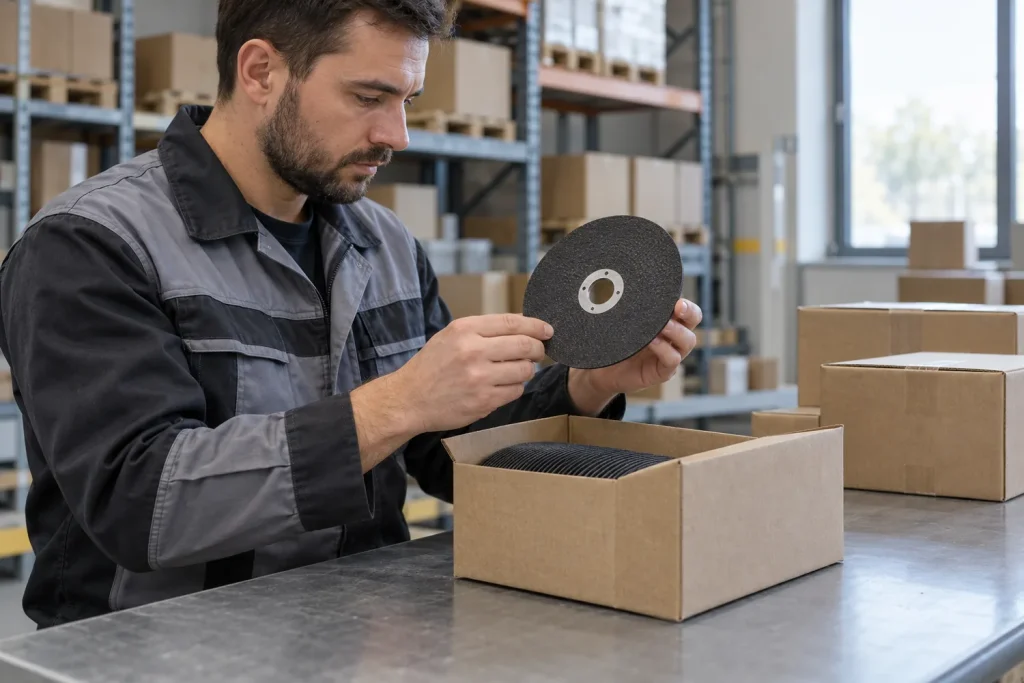
6. Design packing around fragile wheels and traceable batches
Agree the number of wheels per inner pack and master carton, protective dividers or sleeves, maximum carton gross weight, pallet support and stacking limits. Packaging must prevent edge impacts and bending during normal handling. Keep resin wheels away from goods that can crush or puncture cartons in a mixed load. A robust outer carton is useful only if the wheels inside are supported as intended.
Mark outer cartons with SKU, wheel size, intended application, quantity, lot, manufacturer date or validity date as applicable, and handling instructions. Private-label artwork needs a controlled approval that includes mandatory safety information and the actual manufacturer identification required in the target market. Make sure the wheel marking, inner box, master carton and packing list agree. For broader traceability, see our packaging and receiving guide.
7. Inspect shipments without treating visual checks as certification
Before shipment, identify lots and select packs from across the presented stock according to an agreed inspection plan. Verify SKU and counts; measure a defined sample of outside diameter, thickness and bore with appropriate instruments; and check markings, date coding, box condition and protective packing against the approved specification. Record damaged or mislabelled units and set them aside for review. Our inspection planning guide explains how to define the lot and decision rules.
At receiving, check for crushed or wet cartons and confirm that the remaining shelf life and batch identity meet the purchase order. Do not release cracked, chipped, warped, damp or otherwise suspect wheels. An intact-looking wheel is not proof of internal soundness or a passed strength test. Handle any questionable lot under the supplier’s documented procedure.
Inspection and mounting requirements vary by jurisdiction and wheel type. OSHA’s US general-industry rule describes inspection and a ring test before mounting, while also noting that organic-bonded wheels do not sound like vitrified wheels. Apply the governing local requirements and the manufacturer’s procedure; do not use an improvised sound check as a universal certificate of safety.
8. Compare cost per usable cut, not only price per disc
Calculate the landed cost per disc from the actual purchase price, freight allocation, duties and other relevant charges, then compare trial performance under controlled conditions. As an illustrative calculation, if wheel A costs $1.20 landed and makes 30 acceptable trial cuts, its trial material cost is $0.04 per cut. If wheel B costs $0.90 and makes 15 comparable cuts, it is $0.06 per cut. This excludes labor, machine time, returns and test variation; it is not a market-price claim.
Keep purchase economics connected to quality evidence and sell-through. An apparently cheap batch with insufficient remaining life may need discounting or disposal before customers can use it. On the other hand, a higher-priced product should not be accepted merely because its packaging promises more cuts; request comparable trial and traceability records.
Purchase-order checklist
- Intended material, operation, machine category and destination market.
- Wheel type, diameter, thickness, bore, abrasive, bond, reinforcement and approved mounting.
- Maximum RPM and, where applicable, peripheral speed, plus legible wheel markings.
- Applicable product standard, exact claim, test evidence and artwork revision.
- Date-code meaning, storage conditions and minimum remaining shelf life at the agreed receipt point.
- Inner pack, carton protection, lot marking, inspection plan and disposition of damaged stock.
A dependable cutting-wheel range starts with the application and follows the same SKU through supplier approval, dated stock, shipment and receiving. That gives buyers a clearer basis for comparing both safety evidence and commercial performance.
Images are original AI-generated editorial illustrations, not photographs of a verified product, test, factory or shipment.